Don’t fall for trendy investments

People frequently fall for investment tricks, thinking that the only way to earn big returns is to do the latest trendy thing. Unless you have access to a sitting politician’s financial advisor to benefit from insider trading, you’re not likely to do much better than the average market return. Chasing trends is almost guaranteed to do worse. (And insider trading gets you in jail unless you’re politically connected.)

Basic Personal Finance Chapter 9 talks about real estate as an investment. Spoiler: It’s not very good. The long-term real rate of return of home ownership is negative 0.5%. You can probably do better with rental properties, but that’s a pretty high-risk, high-stress investment.

In Chapter 7, we warned against high-risk investments like futures, options, and commodities without really getting into the details. One of the biggest commodities being pushed since 2021 is gold. Actually, it’s always been pushed as a hedge against inflation, but a lot of people didn’t take it seriously until inflation really kicked up in 2021.

Ben Carlson, recently had a post on his site, A Wealth of Common Sense, that included a chart based on Jeremy Sigel’s book, Stocks for the Long Run.
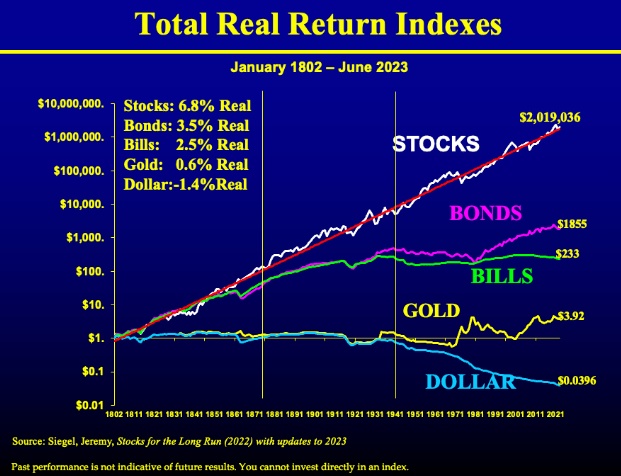
That puts gold into perspective as an investment vehicle. The total real return for gold was 0.6% compared to stocks at 6.8%. Why the difference? Gold doesn’t produce anything, whereas stocks are ownership in companies that take resources (like gold) and create value by producing things worth more than those resources. In the language of Section 7.1 (Investing vs. Saving) of Basic Personal Finance: Gold is a resource for preservation of capital, not for capital growth.

Just think about the companies encouraging you to purchase gold to save you from the collapse of the dollar: they’re willing to take your soon-to-be-worthless dollars and give you their all-important gold. If it’s so important, why are they selling it? This was highlighted perfectly by Zach Weinersmith in his SMBC comic (image used by permission).

Currently the inflation-adjusted price of gold is near record high: $2,039.15. There are only three other peaks that exceed that amount:

  • Feb 1980, afterwhich gold lost nearly 60% of its value in the next 18 months
  • Aug 2011, afterwhich gold lost 45% of its value by Nov 2015
  • Aug 2020, afterwhich gold dropped 26% by Sep 2022

If gold isn’t your thing, you may be tempted to chase other trendy things like cryptocurrency or some hot new stock. The problem there is that once you hear a lot of hype about a particular investment, it most likely is no longer a great investment. Recall the efficient market hypothesis: new information is incorporated nearly instantly so you can’t consistently do better than the average market return. Once the hype starts, the price of the new “super investment” is already inflated to reflect that hype. Even day traders know the motto: “buy low, sell high.” Once there’s hype, you’re buying high. Of course, it could go higher. That’s why the people who initially bought the new “super investment” talk it up to encourage more investors. That makes their investment better.

Basic Personal Finance makes the case that “disciplined saving and patient, long-term investing are the simplest, most consistent ways to accumulate wealth.” Start early because “time in the market is more important than timing the market.” You should be making monthly contributions (dollar-cost averaging) to a no-load, open-end, broad market index fund and grow your nest egg to at least $500K before you start to think about doing anything fancy or hiring a financial planner/advisor.

January is a good time to check your investments

The start of a new year is a good time to review your retirement account(s) to check your investment position, especially if you just created a new account last year. It’s common for investment companies that manage corporate retirement plans to default contributions into government bond funds or money market funds. 

Recently a young adult asked me to look at his Roth IRA account from a local credit union. He was wondering why there were four identical payments during the year, since his money was supposed to be in an S&P 500 index fund. 

It turns out his credit union created a Roth IRA savings account, not an investment account. The young adult said he should have known something was wrong when he created the account; when he asked how the money was being invested, the representative at the credit union said they couldn’t divulge that information. 

Fortunately, he caught the error early, so he didn’t waste too many years of compounding. If this error had continued for 30 years, he would have had a very rude awakening at how poorly prepared he’d be for retirement. The savings account paid 2% in quarterly installments, so the effective rate was (1 + 0.02/4)^4 – 1 = 2.015%, not exactly a good return when inflation is 3.4% (based on 12-month CPI change for December 2023, the latest available from Bureau of Labor Statistics). 

If the institution had invested the money in an S&P 500 index fund, the return for 2023 would have been at least 10 times higher. The Wall Street Journal reports the index was up “about 24% in 2023,” and Seeking Alpha says “just under 25% in 2023.” Actual S&P 500 funds did better because of dividend reinvestment. The total return from 2023 for S&P 500 index funds was 26.29% according to Slickcharts, which mirrors the returns from the index funds offered by Vanguard and Fidelity.

For a $6,000 balance at the start of the year, that’s over $1,400 of lost gains ($1,577.40 vs.  $120.90), even more when you consider future gains on that money if it were invested for the next 30+ years.

Whether the account mix-up was an innocent mistake by the credit union or on purpose to benefit themselves at the expense of a naïve customer is irrelevant to the customer’s financial health. The same could happen to anyone who doesn’t pay attention. 

Just because you have a retirement account (401k, 403b, 459b, IRA, etc.) doesn’t mean you have money properly invested for your future. Make sure you take the time to know where your money is invested. Don’t blindly trust some anonymous account manager. Nobody is going to care about your retirement savings more than you.

Envy is not good for financial wellbeing

Envy is defined as “a feeling of discontented or resentful longing aroused by someone else’s possessions, qualities, or luck.” It’s one of the Seven Deadly Sins according to the Catechism of the Catholic Church, and, in The Conquest of Happiness, atheist philosopher Bertrand Russell wrote that envy was one of the strongest causes of unhappiness. Sadly, marketing is all about stirring up envy to convince you that you need something you didn’t even know existed.

Commercials and advertisements are designed to show happy, attractive people using some product with the implication that you, too, could be happy and attractive if you also used it. The explosion of social media only made things worse. A social media feed showing people’s best moments gives readers a false sense of the happiness of others. “Influencer” accounts barrage us with unrealistic depictions of mostly fictitious luxury lifestyles.

Even seemingly trivial, inconsequential things can inflame the envy bug. I’ve done a bag trade experiment many times, with many different types of students. It’s designed to demonstrate how trade makes society better off, simply because different people have different preferences.

Each person gets a paper bag, and they’re told the contents of the bag are theirs to keep. They don’t know what is in any of the bags, which contain different types of candy or “healthy snacks” like raisins. In the first round, participants look inside their own bags and provide a baseline score of overall happiness, based on a scale of one to five. In the second round, the only thing that changes is that students get to see the contents of a few other bags. They are not yet allowed to trade. Every single time I’ve conducted the experiment, the overall level of happiness in the group decreased after seeing other bags. Nothing changed other than their knowledge of what other people have.

It’s like we’re hard-wired for our perception of others to determine our own happiness. The self-esteem bot comic below pretty much sums it up. (Used by permission of Zach Weinersmith, creator of the SMBC comic)

That’s a pretty sad but accurate depiction of human nature. Being aware of this inherent envy can help you overcome it. Trying to keep up with the Joneses is not a good strategy for financial wellbeing.

When you try to set your financial or life goals, think about what makes you happy, not what makes others happy or how you think their perception of your life will make you feel. And you should remember that life is not all about money and possessions. The more material possessions you think you need, the more time you have to spend working to acquire them. Personally, I’d love to have a 10-car garage attached to a house that backs up to a 3-mile twisty road course. If I worked hard enough to afford all of that, I’d never have time to actually enjoy those cars, and I’d likely not have a loving family because I would have neglected them while working so much.

There are lots of articles and studies making the case that money can’t buy happiness (e.g., Time, Psychology Today, American Psychological Association). Of course, if you don’t have any money, you probably disagree, or if you’re bombarded with images of happy people who all have money, you could think their money is the source of that happiness.

What money can buy is a life with less stress, IF you do it correctly. It takes planning for you to budget to live within your means and save aggressively to maintain a realistic lifestyle without being bogged down by debt and other expenses. You won’t be able to do that if you allow envy to seduce you into excessive spending or unrealistic expectations.

MMT proponents are why you can’t afford a house

One of the basic principles of economics is that there is no such thing as a free lunch. Nothing is truly free, because even if something has no monetary cost, the time it takes to acquire or consume the thing is time you can’t spending doing something else.

People seduced by modern monetary theory (MMT) over the last decade and a half should be realizing that their promised free lunch is not truly free. MMT basically says that governments can print all the money they want without having any negative consequences on the economy. The rapid increase in inflation and mortgage rates over the last couple of years demonstrates that there is a consequence for recklessly extravagant government spending.

Prior to the blissful ignorance of MMT proponents, economists frequently talked about the crowding out effect and monetary devaluation (i.e., inflation) of excessive government debt. When the government has to borrow money to cover a deficit, the extra demand for financial resources drives up the price of money (i.e., interest rates) for everyone. For a long time, international investors were willing to buy up a large share of the debt issued by the Federal Reserve, so rates did not rise as would be expected.

This emboldened the MMT proponents whose advice encouraged free-spending politicians looking to buy favor from the electorate and their campaign donors. Unfortunately, the massive increase in spending during the COVID response coincided with reduced debt purchases by foreign investors and bought MMT face-to-face with reality. As philosopher Dallas Willard wrote, “We can think of reality as what you run into when you are wrong.”

How much did spending increase? According to the Economic Report of the President (Table B-46), over the last decade (2015-2024) government revenue increased 2.8% (the 2023 and 2024 figures are estimates). Over that same period government spending increased 24%. To put that in perspective, over the decade before that (2005-2015), government revenue increased 3.6% compared to spending increasing 4.7%.

Looking at the foreign share of the debt (Table B-52), from the beginning of 2020 to the end of 2022, the federal debt increased 32.6% ($7.7 trillion), but the foreign ownership of the debt only increased 5.2% ($365B). The foreign share of the debt dropped from 29% to 23%. That means the new borrowing was done domestically, so the impact on the economy is no longer covered up by foreign investors.

The cost comes from both increased prices and increased interest rates. Using Consumer Price Index figures from the Minneapolis Fed, the last five years of data (2019-2023) shows an increase of 19%, over triple the previous five-year period: CPI grew 6.1% from 2014-2018. If you buy your own groceries, you’ll realize that some prices increased even more. Here are a few I tracked between 2020 and 2023:

  • Distilled water – up 22%
  • Whole milk – up 42%
  • Greek yogurt – up 49%
  • Canned cat food – up 37%

The chart below shows the 30-year and 15-year fixed rate mortgage rates over the last ten years (Source: FreddieMac). The rates were down to 2.66% in December 24, 2020, likely due to the lockdowns in response to COVID. Since then, they’ve shot up to 7.79% on October 26, 2023 (the last data point on the graph). Bankrate reported that the average rate for 30-year fixed mortgages was 8.01% during the final week of October. (There is some difference in the data as FreddieMac numbers are “based on actual applications from lenders across the country that are submitted to Freddie Mac” and Bankrate’s numbers are based on a “weekly national survey of large lenders.”)

What does this mean for you? More expensive homes that cost more to finance.

The 2019 edition of my book used an example of a $200,000 home, financed at 4% after a 20% down payment. That results in a payment of $763.86 and a total interest of $114,991 paid over the 30-year term. For the 2023 edition, I used a $300,000 home, financed at 7% with 20% down. The monthly payment doubled ($1,596.73) and the total interest paid nearly tripled ($334,821). That was written while rates were still climbing.

That same $300,000 home financed at 8% instead of 7% will have a monthly payment that is 10% more ($165) and cost nearly 18% more ($60,000) in total interest over the life of the loan.

Things would be even worse if you buy an average home. I used the $300K figure assuming a smaller, entry-level home. According to the St Louis Fed, the average sale price of houses sold in the U.S. rose from $375K in Q2 2020 to $552K in Q4 2022. That’s a 47% increase, well above inflation based on CPI.

Thanks to politicians using MMT to justify their spending habits, 2023 is a terrible time to be a home buyer.

Companies Make Big Money Off People Who Don’t Pay Attention

You hear a lot of people moaning that the rich get rich on the backs of the poor. A more plausible source of riches comes from people who don’t pay attention. This is a frequent warning I give to students, especially when talking about banking and ATM machines. (A couple years ago, I learned that companies like McDonalds pay employees with prepaid debit cards if they don’t have bank accounts for direct deposit, and I was shocked to learn that kids were paying $4 fees to cash $20 paychecks.)

Today I added several more data points to support the “riches from the ignorant” hypothesis. I had my car serviced; just an oil and filter change and tire rotation. (Yes, I can do it myself, but I had a coupon that got it all done for under $30, with tax.) The service scammer (she claimed “advisor”) told me the technician recommended several things: a fuel injector cleaning, a coolant flush, a brake fluid flush, and a wheel alignment “because you have some feathering on the outside of the front tires.” The total bill would be $670. Surprisingly, they didn’t recommend an engine air filter change since the manufacturer’s recommended service calls for it at my mileage.

It was easy to spot the scam and decline all the services because I’m familiar with the manufacturer’s service schedule, which I always review before doing anything to the car. The manufacturer recommended interval for a coolant flush is 6 years or 120K miles, but it’s a very high profit service with low materials cost and very little required labor, so dealers push it as often as they can, especially at the change of seasons to “winterize” or “prepare for summer heat.”

The fuel injector service is also a scam because the service manual does not mention a requirement for such a service… ever… at any mileage. Other dealers offer an “induction system cleaning” which basically means cleaning all the plumbing from the intake up to the cylinders… yes, plumbing that’s kept clean by an engine air filter (and up to the air filter is supposed to be cleaned when the filter is replaced). If it’s not in the manufacturer’s recommended maintenance, don’t pay someone to do it.

The alignment claim could be legitimate, if you haven’t already identified a scammer. In my case, I had just had the front suspension bushings replaced under warranty so an alignment had been done less than 5K miles before. Also, I knew I was getting close on my tires so I looked at them carefully before dropping the car off. The wear on each tire was perfectly even.

At a previous visit to this same dealership, the service scammer brought me a dirty engine air filter and suggested I replace it. I thought it odd that my filter could be that dirty because I only had 15K miles at the time and the manual calls for replacements every 35K miles. As usual, I declined. When I got home, I popped the hood and looked at my filter. It was spotless, and it wasn’t even the same size as the one the scammer showed me.

Dealerships aren’t the only scammers out there. On the way back, I stopped for gas and the pump defaulted to premium even though I pushed the button for regular. I’ve seen that happen at this particular gas station before and I wonder how many people don’t notice and pay the extra $5+ for a fill up (figuring $0.50/gal and 10 gal of gas).

 This isn’t exactly a new idea. The phrase “a fool and his money are soon parted” dates back to 1587 (Dr. John bridge, Defence of the Government of the Church of England). This is your reminder to not be a fool with your money.

McDonald’s Kiosks and the Labor-Capital Tradeoff

Earlier this week, there were several stories about McDonald’s adding self-order kiosks. CNBC’s Sarah Whitten did a rare “just the facts” story that says McDonald’s is adding the kiosks to 1000 stores each quarter for the next two years. Sadly, most other stories read like editorials in favor of or against the new technology and blaming or exonerating minimum wage laws. For example, Christian Britschgi at Reason.com insists the kiosks are not a reaction to the minimum wage,  ignoring former McDonald’s CEO, Ed Rensi, crediting “Fight for $15” as the reason for the kiosks two year ago. Let’s look the economics of the issue to avoid getting overtly political.

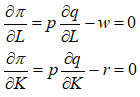
Consider the simplest model of a firm that wants to maximize profit (p ), using two generic inputs, labor (L) and capital (K). We’ll use perfectly competitive input markets, so the firm can use as much of each input as it wants at the prevailing markets’ costs, wage (w) for labor and rental rate of capital (r) for capital. The firm also faces a competitive output market, so it can sell all the output it wants at the market price (p). The firm’s production is a function of both labor and capital, q(L, K), which gives the maximum amount of output for a given level of inputs. The firm’s optimization problem is summarized here:

Labor-Capital Eqn1

Solving this problem is straight forward. Take partial derivatives with respect to both decision variables and set them equal to zero:

Labor-Capital Eqn2

Both of these can be solved for p:

Labor-Capital Eqn3

Where MPL and MPK are the marginal products of labor and capital, respectively. So the ratio of price and productivity for both labor and capital are equal. What does that mean? If any of the four parts of this equation change, the firm will take actions to restore the equality. For example, if the wage doubles, the productivity of the workers would also have to double. Otherwise, the firm will substitute away from labor and employ more capital (until the equality is restored).

In the case of McDonald’s kiosks, the switch to more automation could be the result of better productivity from automation (i.e., higher MPK), but is more likely a “perfect storm” of both artificially increasing wages and increasing productivity from capital. That’s bad news for low-skilled and entry-level workers.

If you want to ensure your employability, focus on improving your productivity (i.e., raise your MPL). You do that by investing in your human capital through better education or job training. Focus on being more productive for your employer rather than simply demanding higher wages.

When to Take Social Security Benefits

Once upon a time, I promised a blog post on when you should take Social Security. Procrastination pays off because The Motley Fool just ran a post that did it for me. The short version: take your benefit as soon as you can (i.e., age 62). The trade-off is to wait and increase your monthly benefit at the expense of lower overall payout from Social Security.

Your “full” retirement age is between 65 and 67, depending on your year of birth. For younger generations, that age will probably increase as the system becomes insolvent. Currently, your monthly benefit increases about 8% for each year you delay your benefits. That could be the right decision if you don’t have enough savings to supplement your benefits. You will need your own savings because the current average Social Security benefit is only $1,372 per month. That’s $16,646 per year, barely above the poverty line for a two-person household. The maximum benefit at “full” retirement age is $2,687 per month ($32,244 per year).

Of course, all this Social Security talk only applies to those lucky enough to reach age 62 while Social Security is still solvent. According to the Board of Trustees, Social Security will pay more in benefits than it collects in taxes, starting in 2034. So if you’re under age 45, you’d better start saving to fund your own retirement. The earlier you start, the better, because of the power of compound interest. Learn more in Basic Personal Finance.

Bubbling Assets Are Not Good Investments

A recent column by Gail MarksJarvis in the Chicago Tribune warned that “Investors Should Be Wary of Bitcoin.” She warns that while Bitcoin has seen 358% gain this year, it’s probably approaching the peak of its asset bubble, and newer investors will get caught holding the hot potato when the bubble pops. They’ll be just like the losers from the 2008 housing crash, the 2000 tech bubble crash, and the Nikkei crash in the 1980s.

I’d like to add a separate warning that also applies to many other alternative investments, like gold or real estate. Often, the rationale for these investments is that they have “real” value or they’re more stable because they don’t rely on the financial system. Really? NOTHING has inherent value unless it can feed you, clothe you, or provide shelter for you. Everything else only has value because people agree on its value.

Take gold, for example. It’s a nice, non-corroding, malleable metal that’s also a good conductor of electricity. What good is it when the economy crashes and the zombie apocalypse starts? You’ll have hunks of metal. That won’t help you grow food or even buy food if there’s none available. It only has value if you find people willing to accept it in exchange for whatever they’re willing to sell.

One of the arguments people use for Bitcoin is that it’s independent of governments and central banks, so it’s more stable than fiat currencies and will survive the pending banking collapse from all the debt problems. Sorry, but nothing that grows at 300% per year is stable. Again, consider the worst case zombie-apocalypse scenario: if the “system” goes and there’s no power generation, what good is cryptocurrency when no one can use a computer to verify you have any?

If you’re really concerned about doomsday economic scenarios, build up a stockpile of food, water, and essential living supplies. If you’re looking for solid financial investments, jumping on an asset bubble is not a long-term strategy.

Financial Discipline Begins with Personal Discipline

You’ve heard the saying, you can’t love others until you first love yourself. The same can be said of your personal finance: You can’t have financial discipline if you don’t have personal discipline.

A new study by CareerBuilder shows that 78% of Americans live paycheck to paycheck. Their survey of 3,462 full-time workers and 2,369 full-time employers showed people struggle to make ends meet even at higher wages. People earning over $100,000 (9%) were living paycheck to paycheck; 28% of those making $50K to $99K do too.

The big problem is behaviors that lead to debt. 71% of those surveyed had some kind of debt and 56% said they would never pay off their debts. The same percentage (56%) save less than $100 per month.

Brittany Jones-Cooper at Yahoo Finance reported on the survey and interviewed a financial planner. He said the first step is to look at non-monetary factors like shopping and drinking in bars to “relieve stress.” The Yahoo story offers a bulleted list of ideas to consider, but it boils down to take personal responsibility. For the most part people don’t live paycheck to paycheck because someone else is not paying them enough. It’s because they are spending too much.

The solution is to create a budget to understand where your money is going. Then develop a plan to cut back the bad habits. You need to have personal discipline to stick to that plan. In time, you’ll learn to live within your means and save at least 10% of your income for the future. It’s all covered in Chapter 3 of Basic Personal Finance.

College Earnings

Georgetown University’s Center on Education and the Workforce has a bunch of reports “to better articulate links between education, career preparation, and workplace demands.” That means they attempt to determine the value of various college degrees and majors based on employment opportunities and wages.

My last post talked about AA degrees that earn more than BA degrees (based on a Chicago Tribune column that referenced a Georgetown study). The Cashlorette.com also used Georgetown data to rank 173 majors based on median income and unemployment rates.

The top 5:
1. Petroleum Engineering
2. Pharmacy Pharmaceutical Sciences/Administration
3. Geological/Geophysical Engineering
4. Mining/Mineral Engineering
5. Naval Architecture/Marine Engineering

The bottom 5:
169. Studio Arts
170. Human Services/Community Organization
171. Composition/Rhetoric
172. Miscellaneous Fine Arts
173. Clinical Psychology

For perspective, number 1 earns more than three times more than last place: $135K vs. $43K. (Remember those are median incomes.)

Think about the future earnings and jobs potential of your academic major, not just how entertaining (or easy) it might be just to get a diploma. The more you earn, the more you can save.