Retirement Planning Includes Plans During Retirement

CNBC ran a story last week pointing out an obvious part of retirement planning that they think people don’t consider: “make sure you don’t run out of money.”

They start with the 4 percent rule recommended by “many investors”-only draw 4% of your total portfolio value in any given year. That way, you’re basically living on the gains, and your portfolio remains intact (assuming a 4% real return). Research by Wade Pfau suggests that the 4% rule may be optimistic if people transition their portfolios to safer investments after retirement, hence earning less than a 4% return.

The story then quotes certified financial planners who state more obvious points, that you should consider three things when planning your retirement spending goals:

  • Life expectancy
  • Social Security benefits
  • Taxes

I’ll start with the last one. You have to consider the required minimum distributions from your retirement plans. Try to balance your tax-deferred (traditional IRA & 401(k)s) and tax-free (Roth) distributions to minimize your taxes. Avoid unnecessary portfolio reallocations, which could increase your tax burden for taxable accounts (i.e., don’t use actively managed mutual funds).

When looking at Social Security benefits (for those retired or retiring soon who will actually have them), consider your objectives. Do you want to maximize your total benefits, or do you want to maximize your monthly benefit? For the former, take your benefits as early as possible. If quality of life is more important, and you don’t need the money right away, waiting to draw social security will increase your monthly payments. (I’ll follow up with a post on this soon.)

Life expectancy is a somber topic, but you really do have to consider how long you might be around to make sure you have enough to support yourself in retirement. If you don’t want to put a specific number to it, pick something far into the future (say 100 years old… or 40 years of retirement). Use that number when planning your nest egg requirement. Other alternatives are to plan on smaller returns than you think you’ll get and/or using random returns and simulating your retirement, as shown in my book and discussed in a previous post.

One thing the article didn’t point out is that all the “help” these professional financial advisors give you will cost you 2-3% of your portfolio value every year. That’s the real reason you won’t be able to draw 4% for yourself. It doesn’t take a PhD in finance, or even a CFP, to plan for your retirement. It’s fairly basic:

  1. Figure out what quality of life you want during retirement (i.e., how much you want to live on each year). This will determine the size of the nest egg you need to have ready when you retire.
  2. Figure out how much you need to start saving now to get there.

Take the time to study the basics and make a plan. You can enjoy spending/saving that 2-3% fee on yourself instead of paying for advice you can easily get on your own.
Under 30? Time is on Your Side. Don’t Waste It.

Nicholas Hopwood has an article in Investopedia (& Business Insider) that says your best asset is your income, not your home or savings. He makes a good point for millennials. (It doesn’t apply to those of us with fewer earning years ahead.)

A home ties up a lot of income and actually increases your expenses. Plus studies show the real return to real estate is negative. For savings, Hopwood is referring to 401(k) balances. There’s not much there for younger workers, but higher income allows you to make the best use of a 401(k) (to reach the $18K maximum contribution).

For young people, time is on your side because of the power of compounding. Anything you do to increase future earnings will be amplified by that extra time. Hopwood says your early income will be tied to your degree or technical expertise, a polite way of saying you should study something that will actually get you a job. Over time, he says attitude, personality and communication skills are most important to income growth.

Just make sure you save at least 10% of that income… and increase that percentage with each pay raise.

Make Your Own Savings Plan

We’re definitely in a period of “fake news.” Two stories on Yahoo make me think April Fool’s Day was postponed to May this year. The first story claims millennials save for financial freedom rather than to leave the workforce and retire. It cites a Merrill Edge study that claims the 18-34 age group is saving more money than any other age group. That’s hard to believe, given a Consumerist article two weeks ago that said nearly half of Americans are not able to cope with a $100 surprise expense. CNBC has run several stories on a March 2016 Economic Policy Institute report that shows median savings are pathetically low: only $480 for ages 32-37.

From the Merrill Edge study, “average income they say they’re saving per year”:

Millennials:   19%
Gen X:             14%
Boomers:        14%
Seniors:           12%

I started to question those numbers, but then realized it’s self-reported. (Re-read that quote above the numbers.) Digging through the article, it says millennials are more likely to spend money on travel, dining, and fitness than to put it into savings.

Sadly, the only thing in the article that rang true was this line: “they’re not thinking about retirement as a phase of life”

Curiously, another article about millennial savings by the same Yahoo author claims millennials are “more eager to pay their own way at younger ages than when baby boomers think they should.” That one claims a Bankrate survey. The funny thing is the conclusion: “The dream of financial independence and the reality of their current financial situation continues to be at odds for many millennials.” Don’t forget, this is the same author that just claimed millennials save more than other generations.

The take away (besides don’t print fake news): don’t make your decisions based on what other people are doing (or claim to be doing). Figure out what quality of life you want during retirement (i.e., how much you want to live on each year), and then figure out how much you need to start saving now to get there. My book helps you figure out how to do that. The important part is to start now. Compound interest isn’t something you get back later.

Don’t Let Your 15 Minutes of Fame Be as a Bad Example

CNBC seems to be highlighting people’s financial mistakes . They started in January with a story about a woman spending $700 a month on Uber. This month, they have two stories: one about a guy with $100K in debt spending $1,100 a month on takeout (nearly 30% of his income!); the other is someone who wasted $41,000 at Amazon on over 1,400 items, none of which she can remember. That last one also links to a story about how consumers underestimate their online purchases.  OpenUp studied 1000 subjects in 2016 and found a big disparity between self-reported purchases and actual purchases (22 items vs 41 items). Fortunately, the personal articles go on to explain the mistakes and show how these people have turned their financial lives around.

It’s not hard to avoid the big financial holes these people dug for themselves. You can learn about financial discipline in Basic Personal Finance (or just about any consumer finance website… of course, my book is better). Don’t let your brief 15 minutes of fame be as a bad example for others to learn from your mistakes.

Emergency Expenses Are Part of Financial Planning

The Consumerist (a service of Consumer Reports) recently reported on a Bloomberg study on Work, Workers and Technology. The nugget they pulled is not related to any of those things; it deals with financial security, and the result is very bad. One thousand respondents were asked if they were prepared for unexpected expenses, and a majority said no. The results:

$1000 expense:  80% could not pay it
$100 expense:  48% could not pay it
$10 expense:  28% “would have to worry about being able to pay”

Most respondents said part of the problem is that their income varies from week to week. At the risk of sounding insensitive, that’s no excuse. One of the first things everyone should do when assessing their financial lives is develop an emergency expense fund (Rule of Thumb #6 in Basic Personal Finance). That goes along with building (and sticking to) a budget to ensure you can live within your means. As I’ve posted before: discipline, not income, prevents debt.

The silver lining is that 73% of respondents expect their kids to do better and make more money. Let’s hope they also do a better job of budgeting and saving that money.


Investors Beware of “Best Investment” Claims

A recent post by Rutgers University’s Center for Real Estate claims owning a rental home is a good investment. From the post: “A comparison of Sharpe ratios suggests the risk-adjusted rate of return to housing in New Jersey might be high relative to both stocks and bonds.” If you read deeper, you realize the author used a little sleight of hand to come to that conclusion.

The study was limited to New Jersey, which itself is misleading for anyone thinking of rental property because NJ is one of the most expensive areas of the country to live (based on the percentage of income people spend on housing). However, the study only used 371 of the 739 ZIP codes because of incomplete data. The study period was 1987-2014 and the investment return was measured by the sum of the income produced (i.e., rental income) and the change in real asset value. These gains were compared to stocks (dividends + capital gains) and bonds (interest payments).

The author reports annual returns that seem reasonable: 9.7 percent for stocks, 6.8 percent for rental real estate, and 4.3 percent for bonds. The claim that rental real estate is a better investment is based on the Sharpe Ratio, a measure of risk-adjusted return calculated by:

(Average_return – Risk_free_rate) ¸ Standard_deviation_of_returns

The Sharpe Ratios were 0.45 for stocks, 0.59 for bonds, and 0.80 for rental property.

Even though the author isn’t trying to sell you rental property, you should always look into someone’s claims. Look at the fine print, and you’ll quickly see a couple issues with this study. First, the rental yields were based on Zillow’s “price-rent” ratio, but that data was only available since 2011. The author estimated the rental yield by assuming it followed the yield on 5-year treasury bonds. Next, the author assumed a 5% “allowance for depreciation, maintenance and property tax.” If you’re going to claim rental property is a better investment based on risk-adjusted measures, you can’t assume away the variability of the asset’s returns! A steady 5% cost is unrealistic from a risk perspective because housing repairs and maintenance are unpredictable and can be very expensive (i.e., thousands of dollars for any one major repair: HVAC, roofing, plumbing, etc.). At least the author admitted “this assumption matters.”

Always be suspicious of anyone claiming some particular investment is the best! Do your homework and check the numbers for yourself as best you can before committing to anything.

Discipline, Not Income, Prevents Debt

A recent post by @akieler on consumerist.com (part of Consumer Reports) reports on a Northwest Mutual commissioned survey that says the average debt (excluding mortgages) for U.S. adults is $37,000. This is a case where being below average would be good!

Although it was an online survey, the results are disturbing:

  • 21% were unsure what portion of their income goes to debt repayment
  • 18% only make minimum payments
  • 14% expect to be in debt for the rest of their lives
  • 25% admit to excessive/frivolous spending

Yet when asked what change would most significantly impact their financial situation, only 7% said “having a comprehensive financial plan.” The most common response was essentially more money (36%). This may sound heartless, but no amount of money will resolve debt problems that result from a lack of fiscal discipline. From the survey: 40% of discretionary income goes to “entertainment, leisure travel, hobbies, etc.”, while only 33% goes to paying off debt. Debt piles up when you’re living beyond your means.

Forty percent of respondents said they experience moderate to high levels of anxiety based on their debt. Despite these feelings, when given the choice of how to spend an extra $2,000, 60% said they would not use it to pay down debt (although 40% said they would put it in savings… a little silver lining).

People who are struggling with debt need to establish fiscal discipline and stick to a budget. That’s Chapter 2 of my book, Basic Personal Finance.

No Excuse Not To Save

Search any finance site and you’re bound to find an article on retirement savings and the importance of starting early. It’s not exactly earth-shattering news, but I read them anyway out of morbid curiosity about the comments. Today’s entertainment (and disappointment) came from a recent Yahoo! Finance story about retirement mistakes to avoid:

  • Not Starting Early
  • Not having a Roth IRA
  • Raiding your retirement account
  • Cashing out your 401(k)

Good advice, but with any article I see on savings, there’s always some comment about how hard it is or “easy for you to say” from someone claiming difficult life circumstances or just flat out hatred for banks or Wall Street. Here are some of the comments from this story (typos and all):

  • Just making financial institutions,FATTER!
  • With rent in Toronto what it is, your dollar earned at Starbucks can only carry you so far. Share your dwelling with 14 other millenials, and you MIGHT have something to spend on your retirement day.
  • DO NOT believe any of these financial advisor’s #$%$. Yes, they have good advice but it doesn’t apply to most of us.
  • Likely the biggest mistake is thinking you’ll be able to retire.
  • Kinda hard to give a damn about retirement when you’re just trying to keep the lights on another week.
  • Unrealistic for the vast majority of young people to start saving at age 25. More like 35 once they establish a career. Every time I read an article that says start saving at 25 I know they are out of touch.

It’s sad that there are so many people who don’t get it. The point of starting early is to benefit from compounding interest. You can actually save less and have more at retirement if you start early. See the example from Chapter 6 of Basic Personal Finance.

The key is being disciplined with your spending. Create a budget to identify frivolous spending and get it under control. Here’s an example from the comments that I wished I had used in the book: “Don’t spend more on coffee every day than you save for retirement every month.”

If you can’t afford to save 10% of your income, you’re living beyond your means. Rather than making excuses for why you can’t save, use your energy thinking of ways that you can save.

Social Security: Take It While You Can!

Today’s post is for the chronologically gifted (i.e., those eligible for Social Security). The conclusion from a Sean Williams article on The Motley Fool: take your benefits while you can. The only way holding off on social security benefits pays off is if you expect to live beyond 85. It’s a morbid thought, thinking about when you’ll die, but that’s the fact of retirement planning. You have to make sure there’s enough money to support yourself while you are alive.

Williams used the average monthly Social Security payout for retirees ($1,363.66) and looked at lifetime payouts for various retirement ages (62 to 70). Assuming 2% cost of living adjustments, the 62-year-old retiree’s payouts exceeds all others until age 85. So if you’re eligible for Social Security, you may as well take it now. You’ll get lower monthly payments but greater total benefits.

For the rest of us, realize how little Social Security actually pays: $1,363.66 x 12 = $16,363.92. That’s not much to live on, even if you have no debt. You need to start planning now to make sure you grow a retirement nest egg that will support the quality of life you want in the future. Also read Chapter 6 of Basic Personal Finance and you’ll realize you’re Social Security benefits will be less than current retirees (if you get any at all).

Median Savings (Again)

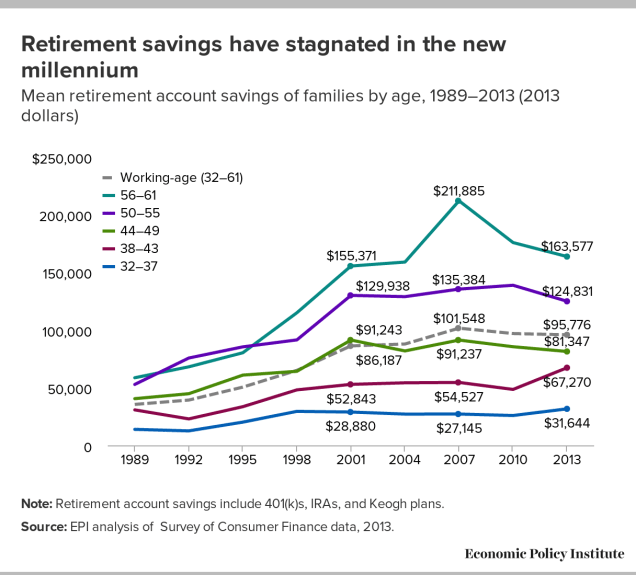
CNBC is milking the Economic Policy Institute report from March 2016 to report “news” over a year later. This time it’s average and median retirement savings for people in their 50s.

Age Average Median
50-55 $124,831 $8,000
56-61 $163,577 $17,000

Note how low those medians are. I used the age 32-37 median (< $500!) on the back cover of Basic Personal Finance. These numbers show that over half the population is not prepared to support themselves in retirement. Don’t let that happen to you. The key is to plan ahead and establish financial discipline early in your life to save for the future. That’s rule #1 in Basic Personal Finance: Pay yourself first!

The original report is here. The table below is their summary chart that was featured in the CNBC story.

5560