Don’t fall for trendy investments

People frequently fall for investment tricks, thinking that the only way to earn big returns is to do the latest trendy thing. Unless you have access to a sitting politician’s financial advisor to benefit from insider trading, you’re not likely to do much better than the average market return. Chasing trends is almost guaranteed to do worse. (And insider trading gets you in jail unless you’re politically connected.)

Basic Personal Finance Chapter 9 talks about real estate as an investment. Spoiler: It’s not very good. The long-term real rate of return of home ownership is negative 0.5%. You can probably do better with rental properties, but that’s a pretty high-risk, high-stress investment.

In Chapter 7, we warned against high-risk investments like futures, options, and commodities without really getting into the details. One of the biggest commodities being pushed since 2021 is gold. Actually, it’s always been pushed as a hedge against inflation, but a lot of people didn’t take it seriously until inflation really kicked up in 2021.

Ben Carlson, recently had a post on his site, A Wealth of Common Sense, that included a chart based on Jeremy Sigel’s book, Stocks for the Long Run.
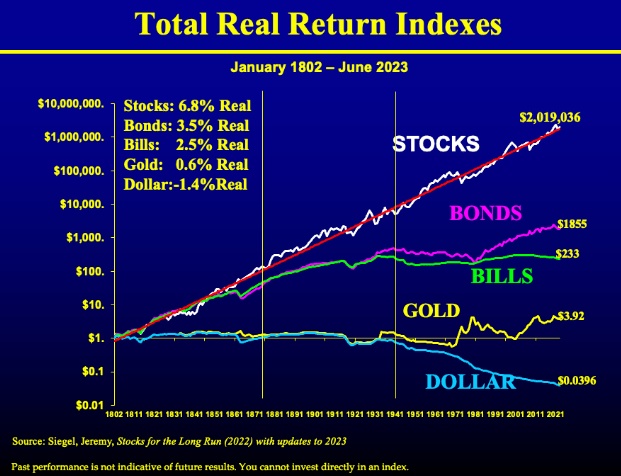
That puts gold into perspective as an investment vehicle. The total real return for gold was 0.6% compared to stocks at 6.8%. Why the difference? Gold doesn’t produce anything, whereas stocks are ownership in companies that take resources (like gold) and create value by producing things worth more than those resources. In the language of Section 7.1 (Investing vs. Saving) of Basic Personal Finance: Gold is a resource for preservation of capital, not for capital growth.

Just think about the companies encouraging you to purchase gold to save you from the collapse of the dollar: they’re willing to take your soon-to-be-worthless dollars and give you their all-important gold. If it’s so important, why are they selling it? This was highlighted perfectly by Zach Weinersmith in his SMBC comic (image used by permission).

Currently the inflation-adjusted price of gold is near record high: $2,039.15. There are only three other peaks that exceed that amount:

  • Feb 1980, afterwhich gold lost nearly 60% of its value in the next 18 months
  • Aug 2011, afterwhich gold lost 45% of its value by Nov 2015
  • Aug 2020, afterwhich gold dropped 26% by Sep 2022

If gold isn’t your thing, you may be tempted to chase other trendy things like cryptocurrency or some hot new stock. The problem there is that once you hear a lot of hype about a particular investment, it most likely is no longer a great investment. Recall the efficient market hypothesis: new information is incorporated nearly instantly so you can’t consistently do better than the average market return. Once the hype starts, the price of the new “super investment” is already inflated to reflect that hype. Even day traders know the motto: “buy low, sell high.” Once there’s hype, you’re buying high. Of course, it could go higher. That’s why the people who initially bought the new “super investment” talk it up to encourage more investors. That makes their investment better.

Basic Personal Finance makes the case that “disciplined saving and patient, long-term investing are the simplest, most consistent ways to accumulate wealth.” Start early because “time in the market is more important than timing the market.” You should be making monthly contributions (dollar-cost averaging) to a no-load, open-end, broad market index fund and grow your nest egg to at least $500K before you start to think about doing anything fancy or hiring a financial planner/advisor.

January is a good time to check your investments

The start of a new year is a good time to review your retirement account(s) to check your investment position, especially if you just created a new account last year. It’s common for investment companies that manage corporate retirement plans to default contributions into government bond funds or money market funds. 

Recently a young adult asked me to look at his Roth IRA account from a local credit union. He was wondering why there were four identical payments during the year, since his money was supposed to be in an S&P 500 index fund. 

It turns out his credit union created a Roth IRA savings account, not an investment account. The young adult said he should have known something was wrong when he created the account; when he asked how the money was being invested, the representative at the credit union said they couldn’t divulge that information. 

Fortunately, he caught the error early, so he didn’t waste too many years of compounding. If this error had continued for 30 years, he would have had a very rude awakening at how poorly prepared he’d be for retirement. The savings account paid 2% in quarterly installments, so the effective rate was (1 + 0.02/4)^4 – 1 = 2.015%, not exactly a good return when inflation is 3.4% (based on 12-month CPI change for December 2023, the latest available from Bureau of Labor Statistics). 

If the institution had invested the money in an S&P 500 index fund, the return for 2023 would have been at least 10 times higher. The Wall Street Journal reports the index was up “about 24% in 2023,” and Seeking Alpha says “just under 25% in 2023.” Actual S&P 500 funds did better because of dividend reinvestment. The total return from 2023 for S&P 500 index funds was 26.29% according to Slickcharts, which mirrors the returns from the index funds offered by Vanguard and Fidelity.

For a $6,000 balance at the start of the year, that’s over $1,400 of lost gains ($1,577.40 vs.  $120.90), even more when you consider future gains on that money if it were invested for the next 30+ years.

Whether the account mix-up was an innocent mistake by the credit union or on purpose to benefit themselves at the expense of a naïve customer is irrelevant to the customer’s financial health. The same could happen to anyone who doesn’t pay attention. 

Just because you have a retirement account (401k, 403b, 459b, IRA, etc.) doesn’t mean you have money properly invested for your future. Make sure you take the time to know where your money is invested. Don’t blindly trust some anonymous account manager. Nobody is going to care about your retirement savings more than you.

Bubbling Assets Are Not Good Investments

A recent column by Gail MarksJarvis in the Chicago Tribune warned that “Investors Should Be Wary of Bitcoin.” She warns that while Bitcoin has seen 358% gain this year, it’s probably approaching the peak of its asset bubble, and newer investors will get caught holding the hot potato when the bubble pops. They’ll be just like the losers from the 2008 housing crash, the 2000 tech bubble crash, and the Nikkei crash in the 1980s.

I’d like to add a separate warning that also applies to many other alternative investments, like gold or real estate. Often, the rationale for these investments is that they have “real” value or they’re more stable because they don’t rely on the financial system. Really? NOTHING has inherent value unless it can feed you, clothe you, or provide shelter for you. Everything else only has value because people agree on its value.

Take gold, for example. It’s a nice, non-corroding, malleable metal that’s also a good conductor of electricity. What good is it when the economy crashes and the zombie apocalypse starts? You’ll have hunks of metal. That won’t help you grow food or even buy food if there’s none available. It only has value if you find people willing to accept it in exchange for whatever they’re willing to sell.

One of the arguments people use for Bitcoin is that it’s independent of governments and central banks, so it’s more stable than fiat currencies and will survive the pending banking collapse from all the debt problems. Sorry, but nothing that grows at 300% per year is stable. Again, consider the worst case zombie-apocalypse scenario: if the “system” goes and there’s no power generation, what good is cryptocurrency when no one can use a computer to verify you have any?

If you’re really concerned about doomsday economic scenarios, build up a stockpile of food, water, and essential living supplies. If you’re looking for solid financial investments, jumping on an asset bubble is not a long-term strategy.

How’s Your Financial Wisdom?

After my last post on baby boomers failing their retirement planning, you might have some smug thoughts that you’re doing much better than them. Here’s a little test, thanks to The Atlantic:

  1. Suppose you had $100 in a savings account and the interest rate was 2 percent per year. After five years, how much do you think you would have in the account if you left the money to grow? A) more than $102; B) exactly $102; C) less than $102; D) do not know; refuse to answer.
  2. Imagine that the interest rate on your savings account is 1 percent per year and inflation is 2 percent per year. After one year, would you be able to buy A) more than, B) exactly the same as, or C) less than today with the money in this account?; D) do not know; refuse to answer.
  3. Do you think that the following statement is true or false? “Buying a single company stock usually provides a safer return than a stock mutual fund.” A) true; B) false; C) do not know; refuse to answer.

The correct answers are 1-A; 2-C; and 3-B.

Based on a survey by economists Annamaria Lusardi and Olivia Mitchell, only 30 percent of Americans answered all three questions correctly. Their findings are published by American Economic Association (subscription required).

The Atlantic author warns that financial ignorance becomes more devastating in a modern economy. Fortunately, the study authors found that basic financial education can boost someone’s economic situation (by 82% of initial wealth for people with low levels of formal education and 56% for college graduates).

If you’re reading a personal finance blog (or read my book), you probably did pretty well on the test. Try to share your financial knowledge with someone you know who needs the help. They might not even know it. Start with the quiz.

Retirement Mistakes Before Retirement

Here’s an article from Yahoo! Finance that points out retirement mistakes many people make well before they get to retirement:

  1. Not starting early
  2. Not having a Roth IRA
  3. Raiding your retirement account
  4. Cashing out your 401(k)

The article quotes a lot from CPA and “retirement expert” Ed Slott. He points out that starting early and maximizing your Roth IRA every year (age 25 to 65) is basically all you need to do to have a million dollar nest egg. If you wait and start 5 years later, you’ll have $200K less in your nest egg.

Mistake #4 is a big one for people who switch jobs. If your next employer doesn’t have a 401(k) plan, or you prefer to manage the money yourself, you can open a 401(k) rollover account. Simply cashing out your 401(k) will incur a 10% penalty, plus a one-time bill for all the taxes owed. Worse, you’ll be giving up the benefit of future tax-deferred earnings.

If you’re unsure what this all means, check out Basic Personal Finance. You can read the first chapter, which lists the 10 rules of thumb for financial success, for free on Amazon. Chapter 6 shows an example of how tax-deferred investments outperform similar investments in taxable accounts.

Retirement Plan Math

A few days ago, I posted the two basic steps of retirement planning.

Step 1: Figure out what quality of life you want during retirement (i.e., how much you want to live on each year). This will determine the size of the nest egg you need to have ready when you retire.

Step 2: Figure out how much you need to start saving now to get there.

Of course, those makes sense to me, but my inner math teacher feels compelled to elaborate for those who need it (even if they won’t ask for it). The calculation for step 1 is a present value formula for an annuity payment. In this case, the payment (PMT) is the amount you want to draw from your portfolio each year in retirement. The present value (PV) is the amount of the portfolio when you retire. (That could be confusing because it’s a present value, but we’re talking about future money; we’ll deal with that later.) You have to specify a real return for the portfolio (r) and the number of years you want to draw this benefit (n). So, if you start with PV in your portfolio at retirement, you can draw PMT from the portfolio each year for n years until you run out of money. You can solve this with the following formula:

Eqn09

If you’re scared of math, you can solve it in Excel: =PV(rate, nper, -pmt). Because Excel looks at time-value-of-money equations as cash flows, enter your PMT value as a negative number. If you don’t, you’ll get the same absolute value, but PV will be negative… no big deal.

For Step 2, you set that present value to a future value (FV), because that’s what you want your portfolio to be in the future. Now use the future value annuity formula and solve for the payment (PMT), which is the amount you need to invest each year (at a real return, r, for n years) to reach that FV. The formula is:

Eqn12

Again, Excel makes it easy: =PMT(rate, nper, pv, -fv). In this case, add a present value (pv) if you already have some savings started.

Note that the second r and n are not the same as the previous formula. This time n is the number of years you have to save for retirement. The previous n was the number of years you plan to draw on your savings during retirement. Similarly, the r in the PMT formula is the real return you expect to earn while you save for retirement. The r in the PV formula is the real return you expect to earn during retirement (which will probably be lower, assuming safer investments).

This (and lots more financial math) is covered in Basic Personal Finance, but now you have the two most important formulas. You can complicate this by simulating returns to add some realism, or you can simply pad your numbers by using a smaller r in either or both formulas. You can also use a larger n and/or larger PMT in the first formula to pad your nest egg.

Emergency Expenses Are Part of Financial Planning

The Consumerist (a service of Consumer Reports) recently reported on a Bloomberg study on Work, Workers and Technology. The nugget they pulled is not related to any of those things; it deals with financial security, and the result is very bad. One thousand respondents were asked if they were prepared for unexpected expenses, and a majority said no. The results:

$1000 expense:  80% could not pay it
$100 expense:  48% could not pay it
$10 expense:  28% “would have to worry about being able to pay”

Most respondents said part of the problem is that their income varies from week to week. At the risk of sounding insensitive, that’s no excuse. One of the first things everyone should do when assessing their financial lives is develop an emergency expense fund (Rule of Thumb #6 in Basic Personal Finance). That goes along with building (and sticking to) a budget to ensure you can live within your means. As I’ve posted before: discipline, not income, prevents debt.

The silver lining is that 73% of respondents expect their kids to do better and make more money. Let’s hope they also do a better job of budgeting and saving that money.


All CFPs Come From Lake Wobegon

It’s amazing how two people can read the same article and come to completely opposite conclusions. A couple days ago, I mentioned a study by Arizona State professor Hendrick Bessembinder that likened individual stocks to lottery tickets. The study itself looked at all stocks from 1926 and concluded (among other things) that 58% of individual stocks failed to outperform 1-month Treasury bills over their lifetimes. That last part is key. Any stock can have a good day, good month, or good year. Bessembinder pointed out that over half of them do not perform well over their lifetimes (years). Enter your typical financial advisor. For a fee, they’ll reallocate your portfolio every year (or month!) using their super-secret formula to ensure you only have the winner stocks, and you can beat the market average (but only with the advisor’s help). The catch is, you have to beat the average by more than the advisor’s fee PLUS the added trade costs PLUS the additional capital gains taxes you’ll pay.

Bessembinder’s final conclusion was that your typical investor is better served by index funds. As an economist who understands the efficient market hypothesis and many other studies that have the same conclusions, I simply added Bessembinder’s study as another data point supporting index funds. Lauren Rudd read it and decided to channel his inner Lake Wobegon CFP… don’t you know, they all earn above average returns! Rudd claimed some secret unpublished method to construct “portfolios capable of outperforming the S&P 500 index over a 3, 5 and 10-year timeframe.” Anyone can do that with historical data. If, on Feb 5th, Dan Quinn had today’s knowledge of Bill Belichick’s play calls from Feb 5th, the Lombardi Trophy would be in Atlanta.

The saying goes “past performance is not indicative of future performance.” Market returns are essentially random, and anyone who says otherwise is trying to sell you something.

When financial planners face an uncertain future, rather than using known historical returns, their performance rarely lives up to the bluster. Academic studies consistently show the majority of brokers and financial planners underperform the market in the long run. Just last month, the Wall Street Journal reported on academic research showing that 82% of all U.S. stock mutual funds have trailed their respective benchmarks over the last 15 years.

Rudd also claimed that other advisers recommend closed-ended (ETF) index funds. That’s a total straw man argument. Brokers might recommend ETFs (good commissions and/or fees), but everything I’ve read (including my own book) says to use open-ended, low cost (<0.25%) index funds. This will provide higher after-tax and after-expense returns to the majority of investors.


The Future of Trading is Scary

My last post discussed Robinhood’s targeting of millennial investors, suggesting Robinhood was the real winner of the Snap, Inc. IPO. It may be hard to see how they “won,” given that Robinhood allows free trades. What they did was build a customer base by targeting a generation that expects everything to be free.

But how does Robinhood expect to survive as a “sub-discount” broker with free trades? Investopedia has some ideas: (1) low costs (no physical locations or PR campaigns), (2) interest earned from customers’ unused cash deposits, and (3) venture capital. That last one is the real reason Robinhood exists: $16M in venture capital. Future income streams will come from margin trading with a 3.5% fee, phone-assisted trades for $10, and a subscription service for pre- and after-hours trading.

If this is the future of trading, I fear for young investors. Free trades are bad enough because they practically encourage day trading, which is essentially the same as gambling. Trading on margin takes a dangerous thing like day trading and takes it nuclear (pronounce it nuke-you-lar for added emphasis). One of the top rules of gambling is to not do it with money you can’t afford to lose. With margin trading, people are gambling with money they don’t even have. This type of rampant speculation causes asset bubbles and subsequent crashes (see the 1929 Black Tuesday crash or the 2008 real estate crash).

Chapter 7 of Basic Personal Finance clearly explains why most investors would be better off automatically depositing a monthly amount into low-cost index mutual funds, which allow them to diversify and get higher after-tax and after-expense returns.

Young Investors = Easy Prey for Brokers

Years of investment advice boils down to (1) diversify your portfolio and (2) the easiest, cheapest way to do so is with low-cost, index mutual funds. Given this reality, where are brokers going to find new suckers clients? Enter Millennials. An article by Jefferson Graham in USA Today says the Snap, Inc. (i.e., Snapchat app) IPO on 3/2/17 was very popular with investors under 30. As with many IPOs, initial hype led to a strong opening (up 59% in two days). Once people realized Snap, Inc. hasn’t actually monetized Snapchat, several brokers released sell recommendations, and the stock plummeted.

The real winner was Robinhood, a trading app whose users average 30 years of age (median is 26). The company saw a surge in new accounts, and 43% of all its trades on 3/2/17 were for Snap, Inc.

Chapter 7 in my book, Basic Personal Finance, is the longest chapter in the book because we wanted to clearly lay out the case for our recommendation to use low-cost index mutual funds. This is the best after-tax and after-expenses investment for the majority of people. Picking individual stocks is essentially gambling and the brokerage fees will eat away at any gains you might get.