Envy is not good for financial wellbeing

Envy is defined as “a feeling of discontented or resentful longing aroused by someone else’s possessions, qualities, or luck.” It’s one of the Seven Deadly Sins according to the Catechism of the Catholic Church, and, in The Conquest of Happiness, atheist philosopher Bertrand Russell wrote that envy was one of the strongest causes of unhappiness. Sadly, marketing is all about stirring up envy to convince you that you need something you didn’t even know existed.

Commercials and advertisements are designed to show happy, attractive people using some product with the implication that you, too, could be happy and attractive if you also used it. The explosion of social media only made things worse. A social media feed showing people’s best moments gives readers a false sense of the happiness of others. “Influencer” accounts barrage us with unrealistic depictions of mostly fictitious luxury lifestyles.

Even seemingly trivial, inconsequential things can inflame the envy bug. I’ve done a bag trade experiment many times, with many different types of students. It’s designed to demonstrate how trade makes society better off, simply because different people have different preferences.

Each person gets a paper bag, and they’re told the contents of the bag are theirs to keep. They don’t know what is in any of the bags, which contain different types of candy or “healthy snacks” like raisins. In the first round, participants look inside their own bags and provide a baseline score of overall happiness, based on a scale of one to five. In the second round, the only thing that changes is that students get to see the contents of a few other bags. They are not yet allowed to trade. Every single time I’ve conducted the experiment, the overall level of happiness in the group decreased after seeing other bags. Nothing changed other than their knowledge of what other people have.

It’s like we’re hard-wired for our perception of others to determine our own happiness. The self-esteem bot comic below pretty much sums it up. (Used by permission of Zach Weinersmith, creator of the SMBC comic)

That’s a pretty sad but accurate depiction of human nature. Being aware of this inherent envy can help you overcome it. Trying to keep up with the Joneses is not a good strategy for financial wellbeing.

When you try to set your financial or life goals, think about what makes you happy, not what makes others happy or how you think their perception of your life will make you feel. And you should remember that life is not all about money and possessions. The more material possessions you think you need, the more time you have to spend working to acquire them. Personally, I’d love to have a 10-car garage attached to a house that backs up to a 3-mile twisty road course. If I worked hard enough to afford all of that, I’d never have time to actually enjoy those cars, and I’d likely not have a loving family because I would have neglected them while working so much.

There are lots of articles and studies making the case that money can’t buy happiness (e.g., Time, Psychology Today, American Psychological Association). Of course, if you don’t have any money, you probably disagree, or if you’re bombarded with images of happy people who all have money, you could think their money is the source of that happiness.

What money can buy is a life with less stress, IF you do it correctly. It takes planning for you to budget to live within your means and save aggressively to maintain a realistic lifestyle without being bogged down by debt and other expenses. You won’t be able to do that if you allow envy to seduce you into excessive spending or unrealistic expectations.

McDonald’s Kiosks and the Labor-Capital Tradeoff

Earlier this week, there were several stories about McDonald’s adding self-order kiosks. CNBC’s Sarah Whitten did a rare “just the facts” story that says McDonald’s is adding the kiosks to 1000 stores each quarter for the next two years. Sadly, most other stories read like editorials in favor of or against the new technology and blaming or exonerating minimum wage laws. For example, Christian Britschgi at Reason.com insists the kiosks are not a reaction to the minimum wage,  ignoring former McDonald’s CEO, Ed Rensi, crediting “Fight for $15” as the reason for the kiosks two year ago. Let’s look the economics of the issue to avoid getting overtly political.

Consider the simplest model of a firm that wants to maximize profit (p ), using two generic inputs, labor (L) and capital (K). We’ll use perfectly competitive input markets, so the firm can use as much of each input as it wants at the prevailing markets’ costs, wage (w) for labor and rental rate of capital (r) for capital. The firm also faces a competitive output market, so it can sell all the output it wants at the market price (p). The firm’s production is a function of both labor and capital, q(L, K), which gives the maximum amount of output for a given level of inputs. The firm’s optimization problem is summarized here:

Labor-Capital Eqn1

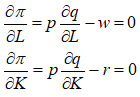
Solving this problem is straight forward. Take partial derivatives with respect to both decision variables and set them equal to zero:

Labor-Capital Eqn2

Both of these can be solved for p:

Labor-Capital Eqn3

Where MPL and MPK are the marginal products of labor and capital, respectively. So the ratio of price and productivity for both labor and capital are equal. What does that mean? If any of the four parts of this equation change, the firm will take actions to restore the equality. For example, if the wage doubles, the productivity of the workers would also have to double. Otherwise, the firm will substitute away from labor and employ more capital (until the equality is restored).

In the case of McDonald’s kiosks, the switch to more automation could be the result of better productivity from automation (i.e., higher MPK), but is more likely a “perfect storm” of both artificially increasing wages and increasing productivity from capital. That’s bad news for low-skilled and entry-level workers.

If you want to ensure your employability, focus on improving your productivity (i.e., raise your MPL). You do that by investing in your human capital through better education or job training. Focus on being more productive for your employer rather than simply demanding higher wages.

“Refresh our Recollections of These Rights”

Happy Independence Day. Whatever you do today to celebrate our nation’s birth, take time to follow the advice of Thomas Jefferson and reflect on the document that gives this day its meaning:

[M]ay [the Declaration of Independence] be to the world, what I believe it will be… the Signal of arousing men to burst the chains, under which monkish ignorance and superstition had persuaded them to bind themselves, and to assume the blessings & security of self-government. [T]hat form which we have substituted, restores the free right to the unbounded exercise of reason and freedom of opinion. [A]ll eyes are opened, or opening, to the rights of man… that the mass of mankind has not been born with saddles on their backs, nor a favored few booted and spurred, ready to ride them legitimately, by the grace of God. [T]hese are grounds of hope for others. [F]or ourselves, let the annual return of this day forever refresh our recollections of these rights, and an undiminished devotion to them.

Jefferson wrote that in a letter on June 24, 1826, respectfully declining an invitation to the fiftieth anniversary celebration of the signing of the Declaration of Independence, because of poor health. He passed away ten days later, on the 4th of July.

If you don’t have time to read the full text of the Declaration of Independence (available here), at least think about the most important part: “We hold these truths to be self-evident, that all men are created equal, that they are endowed by their Creator with certain unalienable Rights, that among these are Life, Liberty and the pursuit of Happiness.–That to secure these rights, Governments are instituted among Men, deriving their just powers from the consent of the governed, “

These words were so powerful that Abraham Lincoln credited its authors with foresight and wisdom and used their words to condemn slavery. During a campaign speech on August 17, 1858, while running for the U.S. Senate, Lincoln said:

In their enlightened belief, nothing stamped with the Divine image and likeness was sent into the world to be trodden on, and degraded, and imbruted by its fellows. They grasped not only the whole race of man then living, but they reached forward and seized upon the farthest posterity. They erected a beacon to guide their children and their children’s children, and the countless myriads who should inhabit the earth in other ages. Wise statesmen as they were, they knew the tendency of prosperity to breed tyrants, and so they established these great self-evident truths, that when in the distant future some man, some faction, some interest should set up the doctrine that none but rich men, or none but white men, were entitled to life, liberty and the pursuit of happiness, their posterity might look up again to the Declaration of Independence and take course to renew the battle which their fathers began.

At least for today, put aside any petty squabbles among political factions (the government’s closed today anyway). Reflect on the blessings of liberty, and celebrate the truly unique document that created our nation and acknowledged our freedoms as gifts from God, not government.

Student Loans Can Be an Albatross

A recent Washington Examiner article quoted some data from the 2017 Student Loan Report, and the results are disturbing:

  • 27% believe the Department of Education will forgive all or part of their loan balance
  • 20% believe there are no negative consequences for the cosigner if they make late payments
  • 22% didn’t know their debt balance within $500
  • 36% didn’t know their monthly payment within $20

The average loan amount is nearly $28K. For that much money, you’d think they’d pay attention to the forms they signed. Worse, many didn’t even know what they were going in debt for. From the survey, almost 55% regret borrowing as much as they did, and almost a quarter plan to have parents help pay the loans.

The survey was based on 400 students polled after a screener question to ensure participants met the requirements (four-year college graduates from class of 2017). We can only hope they’re not representative of the 44M+ student loan borrowers out there… those cosigners really better hope.

Chapter 3 of my book, Basic Personal Finance, opens with “The easiest way to get in trouble with money is to not pay attention to it.” The book also covers the concept of good and bad debt. While student loans can be considered good debt, students really need to consider the benefits relative to the costs incurred. Sadly, only the latter is known up front. (Judging from the survey, some students might not even know that!) Many students go into college without a plan of what to study or what career they want to pursue, making it difficult to really quantify the benefit of college. They’re likely to incur debt with little or no benefit to future earnings.

Here’s a short list of what bachelor’s degrees are worth by major (2016 average annual salary):

Engineering                                     $64,891
Computer Science                           $61,321
Math and Sciences                          $55,087
Business                                            $52,236
Agriculture/Natural Resources     $48,729
Healthcare                                        $48,712
Communications                             $47,047
Social Sciences                                $46,585
Humanities                                      $46,065
Education                                         $34,891

Those are salaries for people who actually get jobs. For comparison, the Bureau of Labor Statistics reports the average annual salary (2015) for workers with a high school diploma was $35,256 (workers over 25 years old in full-time jobs, not starting salaries). So, when thinking about a school loan, consider the difference between your expected salary in your chosen field and a salary with no college. That’s what your investment in education is buying you. From this data, you shouldn’t go into debt if you’re planning to get a degree in education.