Don’t fall for trendy investments

People frequently fall for investment tricks, thinking that the only way to earn big returns is to do the latest trendy thing. Unless you have access to a sitting politician’s financial advisor to benefit from insider trading, you’re not likely to do much better than the average market return. Chasing trends is almost guaranteed to do worse. (And insider trading gets you in jail unless you’re politically connected.)

Basic Personal Finance Chapter 9 talks about real estate as an investment. Spoiler: It’s not very good. The long-term real rate of return of home ownership is negative 0.5%. You can probably do better with rental properties, but that’s a pretty high-risk, high-stress investment.

In Chapter 7, we warned against high-risk investments like futures, options, and commodities without really getting into the details. One of the biggest commodities being pushed since 2021 is gold. Actually, it’s always been pushed as a hedge against inflation, but a lot of people didn’t take it seriously until inflation really kicked up in 2021.

Ben Carlson, recently had a post on his site, A Wealth of Common Sense, that included a chart based on Jeremy Sigel’s book, Stocks for the Long Run.
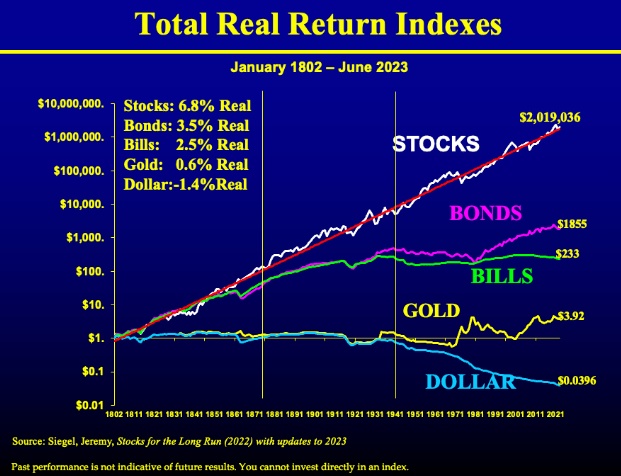
That puts gold into perspective as an investment vehicle. The total real return for gold was 0.6% compared to stocks at 6.8%. Why the difference? Gold doesn’t produce anything, whereas stocks are ownership in companies that take resources (like gold) and create value by producing things worth more than those resources. In the language of Section 7.1 (Investing vs. Saving) of Basic Personal Finance: Gold is a resource for preservation of capital, not for capital growth.

Just think about the companies encouraging you to purchase gold to save you from the collapse of the dollar: they’re willing to take your soon-to-be-worthless dollars and give you their all-important gold. If it’s so important, why are they selling it? This was highlighted perfectly by Zach Weinersmith in his SMBC comic (image used by permission).

Currently the inflation-adjusted price of gold is near record high: $2,039.15. There are only three other peaks that exceed that amount:

  • Feb 1980, afterwhich gold lost nearly 60% of its value in the next 18 months
  • Aug 2011, afterwhich gold lost 45% of its value by Nov 2015
  • Aug 2020, afterwhich gold dropped 26% by Sep 2022

If gold isn’t your thing, you may be tempted to chase other trendy things like cryptocurrency or some hot new stock. The problem there is that once you hear a lot of hype about a particular investment, it most likely is no longer a great investment. Recall the efficient market hypothesis: new information is incorporated nearly instantly so you can’t consistently do better than the average market return. Once the hype starts, the price of the new “super investment” is already inflated to reflect that hype. Even day traders know the motto: “buy low, sell high.” Once there’s hype, you’re buying high. Of course, it could go higher. That’s why the people who initially bought the new “super investment” talk it up to encourage more investors. That makes their investment better.

Basic Personal Finance makes the case that “disciplined saving and patient, long-term investing are the simplest, most consistent ways to accumulate wealth.” Start early because “time in the market is more important than timing the market.” You should be making monthly contributions (dollar-cost averaging) to a no-load, open-end, broad market index fund and grow your nest egg to at least $500K before you start to think about doing anything fancy or hiring a financial planner/advisor.

MMT proponents are why you can’t afford a house

One of the basic principles of economics is that there is no such thing as a free lunch. Nothing is truly free, because even if something has no monetary cost, the time it takes to acquire or consume the thing is time you can’t spending doing something else.

People seduced by modern monetary theory (MMT) over the last decade and a half should be realizing that their promised free lunch is not truly free. MMT basically says that governments can print all the money they want without having any negative consequences on the economy. The rapid increase in inflation and mortgage rates over the last couple of years demonstrates that there is a consequence for recklessly extravagant government spending.

Prior to the blissful ignorance of MMT proponents, economists frequently talked about the crowding out effect and monetary devaluation (i.e., inflation) of excessive government debt. When the government has to borrow money to cover a deficit, the extra demand for financial resources drives up the price of money (i.e., interest rates) for everyone. For a long time, international investors were willing to buy up a large share of the debt issued by the Federal Reserve, so rates did not rise as would be expected.

This emboldened the MMT proponents whose advice encouraged free-spending politicians looking to buy favor from the electorate and their campaign donors. Unfortunately, the massive increase in spending during the COVID response coincided with reduced debt purchases by foreign investors and bought MMT face-to-face with reality. As philosopher Dallas Willard wrote, “We can think of reality as what you run into when you are wrong.”

How much did spending increase? According to the Economic Report of the President (Table B-46), over the last decade (2015-2024) government revenue increased 2.8% (the 2023 and 2024 figures are estimates). Over that same period government spending increased 24%. To put that in perspective, over the decade before that (2005-2015), government revenue increased 3.6% compared to spending increasing 4.7%.

Looking at the foreign share of the debt (Table B-52), from the beginning of 2020 to the end of 2022, the federal debt increased 32.6% ($7.7 trillion), but the foreign ownership of the debt only increased 5.2% ($365B). The foreign share of the debt dropped from 29% to 23%. That means the new borrowing was done domestically, so the impact on the economy is no longer covered up by foreign investors.

The cost comes from both increased prices and increased interest rates. Using Consumer Price Index figures from the Minneapolis Fed, the last five years of data (2019-2023) shows an increase of 19%, over triple the previous five-year period: CPI grew 6.1% from 2014-2018. If you buy your own groceries, you’ll realize that some prices increased even more. Here are a few I tracked between 2020 and 2023:

  • Distilled water – up 22%
  • Whole milk – up 42%
  • Greek yogurt – up 49%
  • Canned cat food – up 37%

The chart below shows the 30-year and 15-year fixed rate mortgage rates over the last ten years (Source: FreddieMac). The rates were down to 2.66% in December 24, 2020, likely due to the lockdowns in response to COVID. Since then, they’ve shot up to 7.79% on October 26, 2023 (the last data point on the graph). Bankrate reported that the average rate for 30-year fixed mortgages was 8.01% during the final week of October. (There is some difference in the data as FreddieMac numbers are “based on actual applications from lenders across the country that are submitted to Freddie Mac” and Bankrate’s numbers are based on a “weekly national survey of large lenders.”)

What does this mean for you? More expensive homes that cost more to finance.

The 2019 edition of my book used an example of a $200,000 home, financed at 4% after a 20% down payment. That results in a payment of $763.86 and a total interest of $114,991 paid over the 30-year term. For the 2023 edition, I used a $300,000 home, financed at 7% with 20% down. The monthly payment doubled ($1,596.73) and the total interest paid nearly tripled ($334,821). That was written while rates were still climbing.

That same $300,000 home financed at 8% instead of 7% will have a monthly payment that is 10% more ($165) and cost nearly 18% more ($60,000) in total interest over the life of the loan.

Things would be even worse if you buy an average home. I used the $300K figure assuming a smaller, entry-level home. According to the St Louis Fed, the average sale price of houses sold in the U.S. rose from $375K in Q2 2020 to $552K in Q4 2022. That’s a 47% increase, well above inflation based on CPI.

Thanks to politicians using MMT to justify their spending habits, 2023 is a terrible time to be a home buyer.

Companies Make Big Money Off People Who Don’t Pay Attention

You hear a lot of people moaning that the rich get rich on the backs of the poor. A more plausible source of riches comes from people who don’t pay attention. This is a frequent warning I give to students, especially when talking about banking and ATM machines. (A couple years ago, I learned that companies like McDonalds pay employees with prepaid debit cards if they don’t have bank accounts for direct deposit, and I was shocked to learn that kids were paying $4 fees to cash $20 paychecks.)

Today I added several more data points to support the “riches from the ignorant” hypothesis. I had my car serviced; just an oil and filter change and tire rotation. (Yes, I can do it myself, but I had a coupon that got it all done for under $30, with tax.) The service scammer (she claimed “advisor”) told me the technician recommended several things: a fuel injector cleaning, a coolant flush, a brake fluid flush, and a wheel alignment “because you have some feathering on the outside of the front tires.” The total bill would be $670. Surprisingly, they didn’t recommend an engine air filter change since the manufacturer’s recommended service calls for it at my mileage.

It was easy to spot the scam and decline all the services because I’m familiar with the manufacturer’s service schedule, which I always review before doing anything to the car. The manufacturer recommended interval for a coolant flush is 6 years or 120K miles, but it’s a very high profit service with low materials cost and very little required labor, so dealers push it as often as they can, especially at the change of seasons to “winterize” or “prepare for summer heat.”

The fuel injector service is also a scam because the service manual does not mention a requirement for such a service… ever… at any mileage. Other dealers offer an “induction system cleaning” which basically means cleaning all the plumbing from the intake up to the cylinders… yes, plumbing that’s kept clean by an engine air filter (and up to the air filter is supposed to be cleaned when the filter is replaced). If it’s not in the manufacturer’s recommended maintenance, don’t pay someone to do it.

The alignment claim could be legitimate, if you haven’t already identified a scammer. In my case, I had just had the front suspension bushings replaced under warranty so an alignment had been done less than 5K miles before. Also, I knew I was getting close on my tires so I looked at them carefully before dropping the car off. The wear on each tire was perfectly even.

At a previous visit to this same dealership, the service scammer brought me a dirty engine air filter and suggested I replace it. I thought it odd that my filter could be that dirty because I only had 15K miles at the time and the manual calls for replacements every 35K miles. As usual, I declined. When I got home, I popped the hood and looked at my filter. It was spotless, and it wasn’t even the same size as the one the scammer showed me.

Dealerships aren’t the only scammers out there. On the way back, I stopped for gas and the pump defaulted to premium even though I pushed the button for regular. I’ve seen that happen at this particular gas station before and I wonder how many people don’t notice and pay the extra $5+ for a fill up (figuring $0.50/gal and 10 gal of gas).

 This isn’t exactly a new idea. The phrase “a fool and his money are soon parted” dates back to 1587 (Dr. John bridge, Defence of the Government of the Church of England). This is your reminder to not be a fool with your money.

When to Take Social Security Benefits

Once upon a time, I promised a blog post on when you should take Social Security. Procrastination pays off because The Motley Fool just ran a post that did it for me. The short version: take your benefit as soon as you can (i.e., age 62). The trade-off is to wait and increase your monthly benefit at the expense of lower overall payout from Social Security.

Your “full” retirement age is between 65 and 67, depending on your year of birth. For younger generations, that age will probably increase as the system becomes insolvent. Currently, your monthly benefit increases about 8% for each year you delay your benefits. That could be the right decision if you don’t have enough savings to supplement your benefits. You will need your own savings because the current average Social Security benefit is only $1,372 per month. That’s $16,646 per year, barely above the poverty line for a two-person household. The maximum benefit at “full” retirement age is $2,687 per month ($32,244 per year).

Of course, all this Social Security talk only applies to those lucky enough to reach age 62 while Social Security is still solvent. According to the Board of Trustees, Social Security will pay more in benefits than it collects in taxes, starting in 2034. So if you’re under age 45, you’d better start saving to fund your own retirement. The earlier you start, the better, because of the power of compound interest. Learn more in Basic Personal Finance.

Financial Discipline Begins with Personal Discipline

You’ve heard the saying, you can’t love others until you first love yourself. The same can be said of your personal finance: You can’t have financial discipline if you don’t have personal discipline.

A new study by CareerBuilder shows that 78% of Americans live paycheck to paycheck. Their survey of 3,462 full-time workers and 2,369 full-time employers showed people struggle to make ends meet even at higher wages. People earning over $100,000 (9%) were living paycheck to paycheck; 28% of those making $50K to $99K do too.

The big problem is behaviors that lead to debt. 71% of those surveyed had some kind of debt and 56% said they would never pay off their debts. The same percentage (56%) save less than $100 per month.

Brittany Jones-Cooper at Yahoo Finance reported on the survey and interviewed a financial planner. He said the first step is to look at non-monetary factors like shopping and drinking in bars to “relieve stress.” The Yahoo story offers a bulleted list of ideas to consider, but it boils down to take personal responsibility. For the most part people don’t live paycheck to paycheck because someone else is not paying them enough. It’s because they are spending too much.

The solution is to create a budget to understand where your money is going. Then develop a plan to cut back the bad habits. You need to have personal discipline to stick to that plan. In time, you’ll learn to live within your means and save at least 10% of your income for the future. It’s all covered in Chapter 3 of Basic Personal Finance.

How’s Your Financial Wisdom?

After my last post on baby boomers failing their retirement planning, you might have some smug thoughts that you’re doing much better than them. Here’s a little test, thanks to The Atlantic:

  1. Suppose you had $100 in a savings account and the interest rate was 2 percent per year. After five years, how much do you think you would have in the account if you left the money to grow? A) more than $102; B) exactly $102; C) less than $102; D) do not know; refuse to answer.
  2. Imagine that the interest rate on your savings account is 1 percent per year and inflation is 2 percent per year. After one year, would you be able to buy A) more than, B) exactly the same as, or C) less than today with the money in this account?; D) do not know; refuse to answer.
  3. Do you think that the following statement is true or false? “Buying a single company stock usually provides a safer return than a stock mutual fund.” A) true; B) false; C) do not know; refuse to answer.

The correct answers are 1-A; 2-C; and 3-B.

Based on a survey by economists Annamaria Lusardi and Olivia Mitchell, only 30 percent of Americans answered all three questions correctly. Their findings are published by American Economic Association (subscription required).

The Atlantic author warns that financial ignorance becomes more devastating in a modern economy. Fortunately, the study authors found that basic financial education can boost someone’s economic situation (by 82% of initial wealth for people with low levels of formal education and 56% for college graduates).

If you’re reading a personal finance blog (or read my book), you probably did pretty well on the test. Try to share your financial knowledge with someone you know who needs the help. They might not even know it. Start with the quiz.

Get Your Kids Ready For College

A new study in England shows incoming college students are woefully unprepared, both for the “reality of life” and for school. Two news articles (Daily Mail and BBC) are based on a Higher Education Policy Institute (HEPI) study of 2,000 incoming university students (incorrectly labeled as millennials by Daily Mail). The study found 61% of respondents are anxious about heading to college, and 27% have panic attacks.

Parents really need to prepare their kids for the realities of college academics. The study says almost half (46%) expect more one-on-one support in college than in high school. A large majority (78%) expect career-planning support. These kids are in for a rude awakening. While students are the stated reason for a university’s existence, many schools receive far more money from research grants, athletic events, and alumni donations than they do from tuition. That means students and their education are rarely the primary focus of a university. The study also says 60% of students expect to spend more time in class in college than in high school. They do not grasp how little time they’ll actually be in class and that they are responsible for their own learning. Professors will not handhold them and “teach the tests” (unlike high schools that have standardized tests linked to teacher pay, for better or worse). The standard rule of thumb is that students should expect to spend at least three hours studying for each one hour in class. I can tell you, from experience, that most students do not follow that advice. Maybe if they’re told to expect to do that work beforehand, they will… call me an optimist.

Since this is a finance blog, I’d like to focus on the fact that more than half the respondents admitted they don’t know how to pay a bill. Over half said they don’t understand student finances, and many underestimate essential expenses. Less than half recognize that rent is likely to be their biggest expense after tuition. Some thought “nights out” or “student societies” would be their biggest expense. Ironically, 78% expect to get more financial advice from their university than they did in high school.

What can you do? If you have or know someone about to start college, take the time to give them some advice on what to expect, both in terms of academics and student life. On the financial side, make sure they know what things cost and how much they have available to them (i.e., make a budget). I’m biased, but I think they should read Basic Personal Finance and realize that a student loan should be treated as an investment (i.e., don’t get one if your degree won’t increase your lifetime earnings).

Retirement Mistakes Before Retirement

Here’s an article from Yahoo! Finance that points out retirement mistakes many people make well before they get to retirement:

  1. Not starting early
  2. Not having a Roth IRA
  3. Raiding your retirement account
  4. Cashing out your 401(k)

The article quotes a lot from CPA and “retirement expert” Ed Slott. He points out that starting early and maximizing your Roth IRA every year (age 25 to 65) is basically all you need to do to have a million dollar nest egg. If you wait and start 5 years later, you’ll have $200K less in your nest egg.

Mistake #4 is a big one for people who switch jobs. If your next employer doesn’t have a 401(k) plan, or you prefer to manage the money yourself, you can open a 401(k) rollover account. Simply cashing out your 401(k) will incur a 10% penalty, plus a one-time bill for all the taxes owed. Worse, you’ll be giving up the benefit of future tax-deferred earnings.

If you’re unsure what this all means, check out Basic Personal Finance. You can read the first chapter, which lists the 10 rules of thumb for financial success, for free on Amazon. Chapter 6 shows an example of how tax-deferred investments outperform similar investments in taxable accounts.

Retirement Plan Math

A few days ago, I posted the two basic steps of retirement planning.

Step 1: Figure out what quality of life you want during retirement (i.e., how much you want to live on each year). This will determine the size of the nest egg you need to have ready when you retire.

Step 2: Figure out how much you need to start saving now to get there.

Of course, those makes sense to me, but my inner math teacher feels compelled to elaborate for those who need it (even if they won’t ask for it). The calculation for step 1 is a present value formula for an annuity payment. In this case, the payment (PMT) is the amount you want to draw from your portfolio each year in retirement. The present value (PV) is the amount of the portfolio when you retire. (That could be confusing because it’s a present value, but we’re talking about future money; we’ll deal with that later.) You have to specify a real return for the portfolio (r) and the number of years you want to draw this benefit (n). So, if you start with PV in your portfolio at retirement, you can draw PMT from the portfolio each year for n years until you run out of money. You can solve this with the following formula:

Eqn09

If you’re scared of math, you can solve it in Excel: =PV(rate, nper, -pmt). Because Excel looks at time-value-of-money equations as cash flows, enter your PMT value as a negative number. If you don’t, you’ll get the same absolute value, but PV will be negative… no big deal.

For Step 2, you set that present value to a future value (FV), because that’s what you want your portfolio to be in the future. Now use the future value annuity formula and solve for the payment (PMT), which is the amount you need to invest each year (at a real return, r, for n years) to reach that FV. The formula is:

Eqn12

Again, Excel makes it easy: =PMT(rate, nper, pv, -fv). In this case, add a present value (pv) if you already have some savings started.

Note that the second r and n are not the same as the previous formula. This time n is the number of years you have to save for retirement. The previous n was the number of years you plan to draw on your savings during retirement. Similarly, the r in the PMT formula is the real return you expect to earn while you save for retirement. The r in the PV formula is the real return you expect to earn during retirement (which will probably be lower, assuming safer investments).

This (and lots more financial math) is covered in Basic Personal Finance, but now you have the two most important formulas. You can complicate this by simulating returns to add some realism, or you can simply pad your numbers by using a smaller r in either or both formulas. You can also use a larger n and/or larger PMT in the first formula to pad your nest egg.

Retirement Planning Includes Plans During Retirement

CNBC ran a story last week pointing out an obvious part of retirement planning that they think people don’t consider: “make sure you don’t run out of money.”

They start with the 4 percent rule recommended by “many investors”-only draw 4% of your total portfolio value in any given year. That way, you’re basically living on the gains, and your portfolio remains intact (assuming a 4% real return). Research by Wade Pfau suggests that the 4% rule may be optimistic if people transition their portfolios to safer investments after retirement, hence earning less than a 4% return.

The story then quotes certified financial planners who state more obvious points, that you should consider three things when planning your retirement spending goals:

  • Life expectancy
  • Social Security benefits
  • Taxes

I’ll start with the last one. You have to consider the required minimum distributions from your retirement plans. Try to balance your tax-deferred (traditional IRA & 401(k)s) and tax-free (Roth) distributions to minimize your taxes. Avoid unnecessary portfolio reallocations, which could increase your tax burden for taxable accounts (i.e., don’t use actively managed mutual funds).

When looking at Social Security benefits (for those retired or retiring soon who will actually have them), consider your objectives. Do you want to maximize your total benefits, or do you want to maximize your monthly benefit? For the former, take your benefits as early as possible. If quality of life is more important, and you don’t need the money right away, waiting to draw social security will increase your monthly payments. (I’ll follow up with a post on this soon.)

Life expectancy is a somber topic, but you really do have to consider how long you might be around to make sure you have enough to support yourself in retirement. If you don’t want to put a specific number to it, pick something far into the future (say 100 years old… or 40 years of retirement). Use that number when planning your nest egg requirement. Other alternatives are to plan on smaller returns than you think you’ll get and/or using random returns and simulating your retirement, as shown in my book and discussed in a previous post.

One thing the article didn’t point out is that all the “help” these professional financial advisors give you will cost you 2-3% of your portfolio value every year. That’s the real reason you won’t be able to draw 4% for yourself. It doesn’t take a PhD in finance, or even a CFP, to plan for your retirement. It’s fairly basic:

  1. Figure out what quality of life you want during retirement (i.e., how much you want to live on each year). This will determine the size of the nest egg you need to have ready when you retire.
  2. Figure out how much you need to start saving now to get there.

Take the time to study the basics and make a plan. You can enjoy spending/saving that 2-3% fee on yourself instead of paying for advice you can easily get on your own.