More Evidence for Index Funds

There are always individual actively-managed mutual funds that bring outstanding returns, but it is rare for these funds to actually outperform passively-managed funds in the long run. According to the Wall Street Journal, 82% of all U.S. stock mutual funds have trailed their respective benchmarks over the last 15 years. Do you think you can pick the 1-in-5 winner? And then, do you think you can switch to the next hot fund before your current hot fund loses its heat?

For those interested in a more complicated answer (i.e., some mix of index and actively-managed funds), another Wall Street Journal article gives some options. However, Danial Solin warns that half of actively-managed funds disappear before then reach 10 years. As for the “winner” funds, he says “There’s no evidence of persistence of performance beyond what you would expect from random chance.”

After accounting to taxes and fees, actively-managed funds are even worse when compared to a passively-managed the index fund. The safe bet is to pick an index fund. Chapter 7 of Basic Personal Finance discusses the topic in more detail.

Hot Stocks Or Hot Potatoes

An article by Jeff Sommer in the New York Times points out the potential rewards of picking individual stocks, but also warns about the riskiness: “Over the long run, while the total stock market has prospered, most individual stocks have not.” He summarizes a study by Arizona State University professor Hendrik Bessembinder, which likened individual stocks to lottery tickets: a small chance of winning with a large chance of making nothing. The study showed that since 1926, over half (58%) of stocks failed to outperform 1-month Treasury bills over their lifetimes (i.e., less than 1% return). All net market returns from 1926 to 2015 were provided by just 4% of stocks.

From the article: “Professor Bessembinder said that he, personally, favors low-cost index mutual fund investing.” Add another data point for the recommendation found in my book Basic Personal Finance.

Investors Beware of “Best Investment” Claims

A recent post by Rutgers University’s Center for Real Estate claims owning a rental home is a good investment. From the post: “A comparison of Sharpe ratios suggests the risk-adjusted rate of return to housing in New Jersey might be high relative to both stocks and bonds.” If you read deeper, you realize the author used a little sleight of hand to come to that conclusion.

The study was limited to New Jersey, which itself is misleading for anyone thinking of rental property because NJ is one of the most expensive areas of the country to live (based on the percentage of income people spend on housing). However, the study only used 371 of the 739 ZIP codes because of incomplete data. The study period was 1987-2014 and the investment return was measured by the sum of the income produced (i.e., rental income) and the change in real asset value. These gains were compared to stocks (dividends + capital gains) and bonds (interest payments).

The author reports annual returns that seem reasonable: 9.7 percent for stocks, 6.8 percent for rental real estate, and 4.3 percent for bonds. The claim that rental real estate is a better investment is based on the Sharpe Ratio, a measure of risk-adjusted return calculated by:

(Average_return – Risk_free_rate) ¸ Standard_deviation_of_returns

The Sharpe Ratios were 0.45 for stocks, 0.59 for bonds, and 0.80 for rental property.

Even though the author isn’t trying to sell you rental property, you should always look into someone’s claims. Look at the fine print, and you’ll quickly see a couple issues with this study. First, the rental yields were based on Zillow’s “price-rent” ratio, but that data was only available since 2011. The author estimated the rental yield by assuming it followed the yield on 5-year treasury bonds. Next, the author assumed a 5% “allowance for depreciation, maintenance and property tax.” If you’re going to claim rental property is a better investment based on risk-adjusted measures, you can’t assume away the variability of the asset’s returns! A steady 5% cost is unrealistic from a risk perspective because housing repairs and maintenance are unpredictable and can be very expensive (i.e., thousands of dollars for any one major repair: HVAC, roofing, plumbing, etc.). At least the author admitted “this assumption matters.”

Always be suspicious of anyone claiming some particular investment is the best! Do your homework and check the numbers for yourself as best you can before committing to anything.
Plan for Uncertainty in Retirement

A column by Gail MarksJarvis in the Chicago Tribune over the weekend talked about the danger of planning your retirement with average returns. It’s a simplified story quoting “experts” rather than explaining the math. Pages 153-156 of Basic Personal Finance illustrate this exact topic with a concrete example. It’s based on The Flaw of Averages, a book by former professor, Sam Savage.

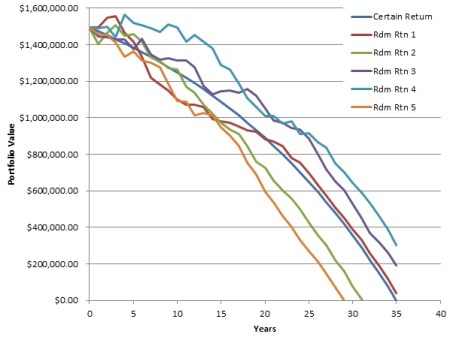
Basic Personal Finance uses a scenario developed in the math appendix: a 35-year plan to live off $80,000 per year from a portfolio of $1.5M that continues to grow at 4%. Using average returns, the portfolio lasts exactly 35 years. Simulating returns with a normal distribution with 4% average and 3% standard deviation, the portfolio runs out of money before year 35 over half the time (53%). As Sam Savage said, “answers from average data are wrong on average.” Here’s the graph from the book that shows 5 random trials along with the certain return plot.

Img12 - Returns

Lesson: either add some stochastic element to your retirement planning or add a good cushion to make sure you can weather the years with returns below the average you plan to earn.


No Excuse Not To Save

Search any finance site and you’re bound to find an article on retirement savings and the importance of starting early. It’s not exactly earth-shattering news, but I read them anyway out of morbid curiosity about the comments. Today’s entertainment (and disappointment) came from a recent Yahoo! Finance story about retirement mistakes to avoid:

  • Not Starting Early
  • Not having a Roth IRA
  • Raiding your retirement account
  • Cashing out your 401(k)

Good advice, but with any article I see on savings, there’s always some comment about how hard it is or “easy for you to say” from someone claiming difficult life circumstances or just flat out hatred for banks or Wall Street. Here are some of the comments from this story (typos and all):

  • Just making financial institutions,FATTER!
  • With rent in Toronto what it is, your dollar earned at Starbucks can only carry you so far. Share your dwelling with 14 other millenials, and you MIGHT have something to spend on your retirement day.
  • DO NOT believe any of these financial advisor’s #$%$. Yes, they have good advice but it doesn’t apply to most of us.
  • Likely the biggest mistake is thinking you’ll be able to retire.
  • Kinda hard to give a damn about retirement when you’re just trying to keep the lights on another week.
  • Unrealistic for the vast majority of young people to start saving at age 25. More like 35 once they establish a career. Every time I read an article that says start saving at 25 I know they are out of touch.

It’s sad that there are so many people who don’t get it. The point of starting early is to benefit from compounding interest. You can actually save less and have more at retirement if you start early. See the example from Chapter 6 of Basic Personal Finance.

The key is being disciplined with your spending. Create a budget to identify frivolous spending and get it under control. Here’s an example from the comments that I wished I had used in the book: “Don’t spend more on coffee every day than you save for retirement every month.”

If you can’t afford to save 10% of your income, you’re living beyond your means. Rather than making excuses for why you can’t save, use your energy thinking of ways that you can save.