Privatizing Social Security, Part I

It Already Happened, and the Detractors Are Silent

I touched on Social Security in Chapter 6 of my book, Basic Personal Finance. It was a simple warning to younger generations to not rely on Social Security because the system will not exist much longer in its current state. In 2016, the Board of Trustees of the Social Security trust fund said the annual cost of the program will exceed its income by 2020. Despite repeated warnings by the Trustees over the years, any attempt to modify or privatize the program has been met with vehement opposition, usually from political talking heads with little actual knowledge of economics, finance, investing, or even basic math.

Take LA Times columnist Michael Hiltzik’s 2015 rant as an example. He tried to leverage recent market crashes into emotional appeals to warn against privatization. Anyone can pick and choose specific days for market returns to make things look horrifically bad. You can also pick specific days to turn anyone into a millionaire. Hiltzik’s column ignored long-term trends and the basics of diversification and asset allocation (i.e., moving to safer investments as retirement approaches) and painted Social Security privatization as if it were the end of civilization as we know it.

The funny thing is, privatized Social Security has existed since 1990 for part-time government employees. The 401(a) FICA Alternative Plan allocates 7.5% of these employees’ salaries into pre-tax private retirement plans (similar to a 401(k)). This is done in lieu of Social Security taxes (typically 6.2% from employee and 6.2% from employer). You don’t hear the privatized Social Security detractors complain about this system. Could it be because the perceived benefit of a state government not paying its matching 6.2% Social Security tax somehow outweighs the “dangers” of part-time employees being pushed into a private retirement system instead of Social Security? Imagine the outcry if a private employer tried to weasel out of its matching Social Security contributions.

What if we could all take advantage of a 401(a)-type privatized Social Security system? Part II will look at comparing returns from Social Security and the stock market.
Non-Financial Rules for Financial Success

In my book Basic Personal Finance, I listed Ten Rules of Thumb for financial success. After that list, I said there are “non-financial rules that have an even bigger impact on whether you live a successful life (e.g., don’t do drugs, don’t get arrested, etc.).” In the back of my mind was a very short list of things I was thinking about, but thought might be too controversial for a finance book. That list was:

  • Don’t do drugs
  • Finish high school
  • Don’t have kids until you’re married

The original person who said that claimed following the list would almost certainly keep a person out of poverty. At the time I wrote the book, I didn’t realize that a similar list was published by the Brookings Institution in 2013, “Three Simple Rules Poor Teens Should Follow to Join the Middle Class.” Their version:

  • Finish high school
  • Get a full-time job
  • Wait until age 21 to marry and have kids

If it was said by Brookings, it must not be that controversial. Plus their list is backed up with research. The article says only 2 percent of adults who followed these rules are in poverty, and 75 percent joined the middle class (earn $55,000+ per year). They don’t say what happened to the rest.

I still like the first list better. After all, doing drugs will make it difficult to keep a full-time job (not to mention the unnecessary expenses of paying for the drugs). Maybe a fourth item for “don’t commit crimes” would also be good to put on the list.

The point is people have the power to get themselves out of poverty, and it has nothing to do with knowing personal finance. The list is short and simple. Unfortunately, as the Brookings article says, following that list is more difficult for people already in poverty, mainly because no one ever tells them how simple the list is.

Plan for Uncertainty in Retirement

A column by Gail MarksJarvis in the Chicago Tribune over the weekend talked about the danger of planning your retirement with average returns. It’s a simplified story quoting “experts” rather than explaining the math. Pages 153-156 of Basic Personal Finance illustrate this exact topic with a concrete example. It’s based on The Flaw of Averages, a book by former professor, Sam Savage.

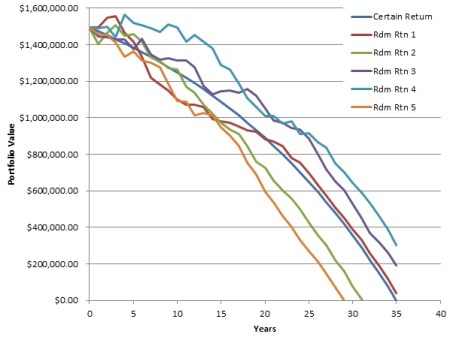
Basic Personal Finance uses a scenario developed in the math appendix: a 35-year plan to live off $80,000 per year from a portfolio of $1.5M that continues to grow at 4%. Using average returns, the portfolio lasts exactly 35 years. Simulating returns with a normal distribution with 4% average and 3% standard deviation, the portfolio runs out of money before year 35 over half the time (53%). As Sam Savage said, “answers from average data are wrong on average.” Here’s the graph from the book that shows 5 random trials along with the certain return plot.

Img12 - Returns

Lesson: either add some stochastic element to your retirement planning or add a good cushion to make sure you can weather the years with returns below the average you plan to earn.


Discipline, Not Income, Prevents Debt

A recent post by @akieler on consumerist.com (part of Consumer Reports) reports on a Northwest Mutual commissioned survey that says the average debt (excluding mortgages) for U.S. adults is $37,000. This is a case where being below average would be good!

Although it was an online survey, the results are disturbing:

  • 21% were unsure what portion of their income goes to debt repayment
  • 18% only make minimum payments
  • 14% expect to be in debt for the rest of their lives
  • 25% admit to excessive/frivolous spending

Yet when asked what change would most significantly impact their financial situation, only 7% said “having a comprehensive financial plan.” The most common response was essentially more money (36%). This may sound heartless, but no amount of money will resolve debt problems that result from a lack of fiscal discipline. From the survey: 40% of discretionary income goes to “entertainment, leisure travel, hobbies, etc.”, while only 33% goes to paying off debt. Debt piles up when you’re living beyond your means.

Forty percent of respondents said they experience moderate to high levels of anxiety based on their debt. Despite these feelings, when given the choice of how to spend an extra $2,000, 60% said they would not use it to pay down debt (although 40% said they would put it in savings… a little silver lining).

People who are struggling with debt need to establish fiscal discipline and stick to a budget. That’s Chapter 2 of my book, Basic Personal Finance.

No Excuse Not To Save

Search any finance site and you’re bound to find an article on retirement savings and the importance of starting early. It’s not exactly earth-shattering news, but I read them anyway out of morbid curiosity about the comments. Today’s entertainment (and disappointment) came from a recent Yahoo! Finance story about retirement mistakes to avoid:

  • Not Starting Early
  • Not having a Roth IRA
  • Raiding your retirement account
  • Cashing out your 401(k)

Good advice, but with any article I see on savings, there’s always some comment about how hard it is or “easy for you to say” from someone claiming difficult life circumstances or just flat out hatred for banks or Wall Street. Here are some of the comments from this story (typos and all):

  • Just making financial institutions,FATTER!
  • With rent in Toronto what it is, your dollar earned at Starbucks can only carry you so far. Share your dwelling with 14 other millenials, and you MIGHT have something to spend on your retirement day.
  • DO NOT believe any of these financial advisor’s #$%$. Yes, they have good advice but it doesn’t apply to most of us.
  • Likely the biggest mistake is thinking you’ll be able to retire.
  • Kinda hard to give a damn about retirement when you’re just trying to keep the lights on another week.
  • Unrealistic for the vast majority of young people to start saving at age 25. More like 35 once they establish a career. Every time I read an article that says start saving at 25 I know they are out of touch.

It’s sad that there are so many people who don’t get it. The point of starting early is to benefit from compounding interest. You can actually save less and have more at retirement if you start early. See the example from Chapter 6 of Basic Personal Finance.

The key is being disciplined with your spending. Create a budget to identify frivolous spending and get it under control. Here’s an example from the comments that I wished I had used in the book: “Don’t spend more on coffee every day than you save for retirement every month.”

If you can’t afford to save 10% of your income, you’re living beyond your means. Rather than making excuses for why you can’t save, use your energy thinking of ways that you can save.

Social Security: Take It While You Can!

Today’s post is for the chronologically gifted (i.e., those eligible for Social Security). The conclusion from a Sean Williams article on The Motley Fool: take your benefits while you can. The only way holding off on social security benefits pays off is if you expect to live beyond 85. It’s a morbid thought, thinking about when you’ll die, but that’s the fact of retirement planning. You have to make sure there’s enough money to support yourself while you are alive.

Williams used the average monthly Social Security payout for retirees ($1,363.66) and looked at lifetime payouts for various retirement ages (62 to 70). Assuming 2% cost of living adjustments, the 62-year-old retiree’s payouts exceeds all others until age 85. So if you’re eligible for Social Security, you may as well take it now. You’ll get lower monthly payments but greater total benefits.

For the rest of us, realize how little Social Security actually pays: $1,363.66 x 12 = $16,363.92. That’s not much to live on, even if you have no debt. You need to start planning now to make sure you grow a retirement nest egg that will support the quality of life you want in the future. Also read Chapter 6 of Basic Personal Finance and you’ll realize you’re Social Security benefits will be less than current retirees (if you get any at all).

Median Savings (Again)

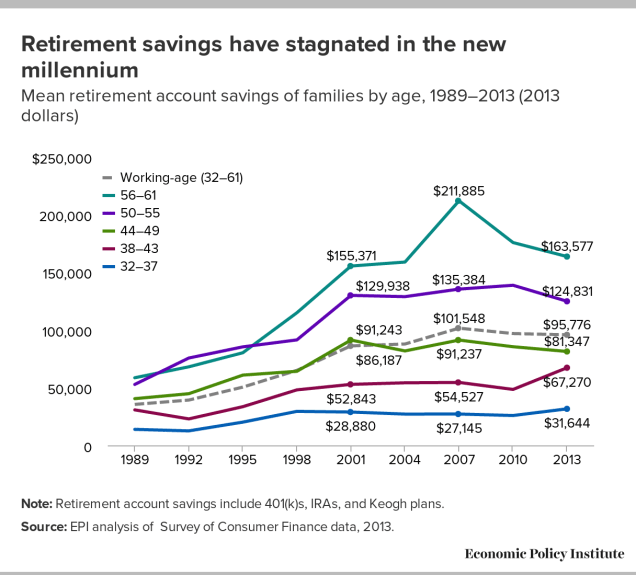
CNBC is milking the Economic Policy Institute report from March 2016 to report “news” over a year later. This time it’s average and median retirement savings for people in their 50s.

Age Average Median
50-55 $124,831 $8,000
56-61 $163,577 $17,000

Note how low those medians are. I used the age 32-37 median (< $500!) on the back cover of Basic Personal Finance. These numbers show that over half the population is not prepared to support themselves in retirement. Don’t let that happen to you. The key is to plan ahead and establish financial discipline early in your life to save for the future. That’s rule #1 in Basic Personal Finance: Pay yourself first!

The original report is here. The table below is their summary chart that was featured in the CNBC story.

5560