More Evidence for Index Funds

There are always individual actively-managed mutual funds that bring outstanding returns, but it is rare for these funds to actually outperform passively-managed funds in the long run. According to the Wall Street Journal, 82% of all U.S. stock mutual funds have trailed their respective benchmarks over the last 15 years. Do you think you can pick the 1-in-5 winner? And then, do you think you can switch to the next hot fund before your current hot fund loses its heat?

For those interested in a more complicated answer (i.e., some mix of index and actively-managed funds), another Wall Street Journal article gives some options. However, Danial Solin warns that half of actively-managed funds disappear before then reach 10 years. As for the “winner” funds, he says “There’s no evidence of persistence of performance beyond what you would expect from random chance.”

After accounting to taxes and fees, actively-managed funds are even worse when compared to a passively-managed the index fund. The safe bet is to pick an index fund. Chapter 7 of Basic Personal Finance discusses the topic in more detail.

Hot Stocks Or Hot Potatoes

An article by Jeff Sommer in the New York Times points out the potential rewards of picking individual stocks, but also warns about the riskiness: “Over the long run, while the total stock market has prospered, most individual stocks have not.” He summarizes a study by Arizona State University professor Hendrik Bessembinder, which likened individual stocks to lottery tickets: a small chance of winning with a large chance of making nothing. The study showed that since 1926, over half (58%) of stocks failed to outperform 1-month Treasury bills over their lifetimes (i.e., less than 1% return). All net market returns from 1926 to 2015 were provided by just 4% of stocks.

From the article: “Professor Bessembinder said that he, personally, favors low-cost index mutual fund investing.” Add another data point for the recommendation found in my book Basic Personal Finance.

Privatizing Social Security, Part III

The Expense of Transition Will Prevent Privatization

The previous posts already showed how privatizing Social Security would result in better returns for beneficiaries and how most opponents to privatization simply make emotional arguments in opposition to privatization. The real reason the system will not get privatized is the same reason the system will eventually collapse: it’s a Ponzi scheme. If that term is too inflammatory, call it a pay-as-you-go system.

John Goodman (not the actor) provides a list of reasons why most democratic voting countries have pay-as-you-go social security systems rather than privatized systems. The main reason is that such a system allows politicians to “appear to meet the need without really paying for it.” Next, the system generates revenues that exceed required payouts in the early years, allowing politicians to raid the “trust fund” to transfer money to their constituents (i.e., buy votes). The system cannot be dismantled because of the “ratchet effect.” That is, as the beneficiary base expands, it becomes too costly to transition them into another system.

As many people have pointed out, the Social Security system will eventually collapse because the number of beneficiaries continues to increase while the number of  contributors per beneficiary is decreasing. The promised benefits impose a huge unfunded liability to the government. Transitioning to a privatized system would be better for future beneficiaries but removes the funding of current beneficiaries. In short, privatizing Social Security would force the government to acknowledge the unfunded liabilities, and the deficit (and debt) would explode. No politician wants to take the blame for that.

Privatizing Social Security, Part II

Comparing Returns

Usually, any opposition to Social Security privatization will use some kind of emotional argument about the risks of stock investing versus the absolute certainty of the safety net embodied by Social Security. They never seem to produce numbers to back up the claims, unless they cite specific days when the stock market performed especially poorly (i.e., any market crash day). You can just as easily pick days when the government performs poorly (e.g., missed someone’s paycheck). That one event doesn’t reflect on all future Social Security payments for all beneficiaries. Let’s try to put some numbers to the argument to compare Social Security to the stock market.

The real return on social security “contributions” was determined by the Social Security Administration by running simulations for beneficiaries born between 1920 and 2004. The return for an individual is difficult to determine because it is based on lifetime earnings and the length of time drawing benefits. That said, the highest return was earned by single-earning couples born in the 1920s: 6.52%. Everyone else will get less. Younger workers have paid higher payroll taxes, so their returns will be lower. Single beneficiaries will earn less because they don’t receive Social Security’s generous spousal benefits. For example, a middle-income single-earning couple born in 1943 will get a 4.59% return, while a single earner with similar income will only earn a 2.49% return. Of course, the returns improve the longer the beneficiaries live, but the simulations show you have to live beyond 85 years old to guarantee a positive return (only half of the people who die between 75 and 84 earn a positive return).

How does that compare to the stock market? The minimum 45-year after-tax average annual return for the S&P 500 index since 1927 is 4.4% (1963-2008). The average is 6.4%, and the standard deviation is 1.1% (based on return data from Aswath Damodaran and inflation data from the Minneapolis Fed, as credited in my book, Basic Personal Finance). So you’re earning a positive return the moment you start saving. Unlike Social Security, this return is not dependent on marital status or longevity, and the proceeds can be passed on (increasing returns to future generations). Under Social Security, if you are single and have no dependent children under 18, your contributions produce zero benefits if you pass away. If you put your money in the stock market, that money could be bequeathed to anyone you specify.

Bonus: It turns out that minimum return of 4.4% is the magic return to ensure ANYBODY saving 12.4% of their income for 45 years could earn his or her salary for 31 years after retirement. Ask anyone drawing Social Security benefits how those checks compare to their salaries when they worked. According to the National Academy of Social Insurance, those benefits will be between 26% and 53% of career-average wages. (The higher number is for lower income earners.)

This is significant because whenever retirement advisors suggest people save at least 10% of their income, detractors say something like, “Easy for you to say. The poor can’t afford to save 10%.” Well, if they were allowed to save their Social Security contributions, that’s 12.4% (including the employer portion).

Let’s look at a worst-case scenario of an individual who makes minimum wage for their entire 45-year working career. We’ll use $7.25/hr with a 40-hour work week and 50 weeks per year. That’s only $14,500 a year. If this person’s 12.4% Social Security tax were invested at 4.4% for 45 years, the retirement account balance would be $242,836. That doesn’t sound like a lot of money, but if the account continued to grow at 4.4%, this individual could live on that money for 31 years and draw $14,500 in each year, the equivalent of the minimum wage salary. (The cool thing is that this works for any annual salary.)

That’s just using basic time-value of money calculations with average returns. A more thorough analysis would simulate real returns to capture the variabilities which could hurt (or benefit) the portfolio. Maybe someone with one of those many university research grants could do that. It would be nice of the proponents and detractors of privatizing Social Security would actually do SOME analysis rather than just regurgitating the tired talking points.
Privatizing Social Security, Part I

It Already Happened, and the Detractors Are Silent

I touched on Social Security in Chapter 6 of my book, Basic Personal Finance. It was a simple warning to younger generations to not rely on Social Security because the system will not exist much longer in its current state. In 2016, the Board of Trustees of the Social Security trust fund said the annual cost of the program will exceed its income by 2020. Despite repeated warnings by the Trustees over the years, any attempt to modify or privatize the program has been met with vehement opposition, usually from political talking heads with little actual knowledge of economics, finance, investing, or even basic math.

Take LA Times columnist Michael Hiltzik’s 2015 rant as an example. He tried to leverage recent market crashes into emotional appeals to warn against privatization. Anyone can pick and choose specific days for market returns to make things look horrifically bad. You can also pick specific days to turn anyone into a millionaire. Hiltzik’s column ignored long-term trends and the basics of diversification and asset allocation (i.e., moving to safer investments as retirement approaches) and painted Social Security privatization as if it were the end of civilization as we know it.

The funny thing is, privatized Social Security has existed since 1990 for part-time government employees. The 401(a) FICA Alternative Plan allocates 7.5% of these employees’ salaries into pre-tax private retirement plans (similar to a 401(k)). This is done in lieu of Social Security taxes (typically 6.2% from employee and 6.2% from employer). You don’t hear the privatized Social Security detractors complain about this system. Could it be because the perceived benefit of a state government not paying its matching 6.2% Social Security tax somehow outweighs the “dangers” of part-time employees being pushed into a private retirement system instead of Social Security? Imagine the outcry if a private employer tried to weasel out of its matching Social Security contributions.

What if we could all take advantage of a 401(a)-type privatized Social Security system? Part II will look at comparing returns from Social Security and the stock market.

Investors Beware of “Best Investment” Claims

A recent post by Rutgers University’s Center for Real Estate claims owning a rental home is a good investment. From the post: “A comparison of Sharpe ratios suggests the risk-adjusted rate of return to housing in New Jersey might be high relative to both stocks and bonds.” If you read deeper, you realize the author used a little sleight of hand to come to that conclusion.

The study was limited to New Jersey, which itself is misleading for anyone thinking of rental property because NJ is one of the most expensive areas of the country to live (based on the percentage of income people spend on housing). However, the study only used 371 of the 739 ZIP codes because of incomplete data. The study period was 1987-2014 and the investment return was measured by the sum of the income produced (i.e., rental income) and the change in real asset value. These gains were compared to stocks (dividends + capital gains) and bonds (interest payments).

The author reports annual returns that seem reasonable: 9.7 percent for stocks, 6.8 percent for rental real estate, and 4.3 percent for bonds. The claim that rental real estate is a better investment is based on the Sharpe Ratio, a measure of risk-adjusted return calculated by:

(Average_return – Risk_free_rate) ¸ Standard_deviation_of_returns

The Sharpe Ratios were 0.45 for stocks, 0.59 for bonds, and 0.80 for rental property.

Even though the author isn’t trying to sell you rental property, you should always look into someone’s claims. Look at the fine print, and you’ll quickly see a couple issues with this study. First, the rental yields were based on Zillow’s “price-rent” ratio, but that data was only available since 2011. The author estimated the rental yield by assuming it followed the yield on 5-year treasury bonds. Next, the author assumed a 5% “allowance for depreciation, maintenance and property tax.” If you’re going to claim rental property is a better investment based on risk-adjusted measures, you can’t assume away the variability of the asset’s returns! A steady 5% cost is unrealistic from a risk perspective because housing repairs and maintenance are unpredictable and can be very expensive (i.e., thousands of dollars for any one major repair: HVAC, roofing, plumbing, etc.). At least the author admitted “this assumption matters.”

Always be suspicious of anyone claiming some particular investment is the best! Do your homework and check the numbers for yourself as best you can before committing to anything.

Non-Financial Rules for Financial Success

In my book Basic Personal Finance, I listed Ten Rules of Thumb for financial success. After that list, I said there are “non-financial rules that have an even bigger impact on whether you live a successful life (e.g., don’t do drugs, don’t get arrested, etc.).” In the back of my mind was a very short list of things I was thinking about, but thought might be too controversial for a finance book. That list was:

  • Don’t do drugs
  • Finish high school
  • Don’t have kids until you’re married

The original person who said that claimed following the list would almost certainly keep a person out of poverty. At the time I wrote the book, I didn’t realize that a similar list was published by the Brookings Institution in 2013, “Three Simple Rules Poor Teens Should Follow to Join the Middle Class.” Their version:

  • Finish high school
  • Get a full-time job
  • Wait until age 21 to marry and have kids

If it was said by Brookings, it must not be that controversial. Plus their list is backed up with research. The article says only 2 percent of adults who followed these rules are in poverty, and 75 percent joined the middle class (earn $55,000+ per year). They don’t say what happened to the rest.

I still like the first list better. After all, doing drugs will make it difficult to keep a full-time job (not to mention the unnecessary expenses of paying for the drugs). Maybe a fourth item for “don’t commit crimes” would also be good to put on the list.

The point is people have the power to get themselves out of poverty, and it has nothing to do with knowing personal finance. The list is short and simple. Unfortunately, as the Brookings article says, following that list is more difficult for people already in poverty, mainly because no one ever tells them how simple the list is.

Plan for Uncertainty in Retirement

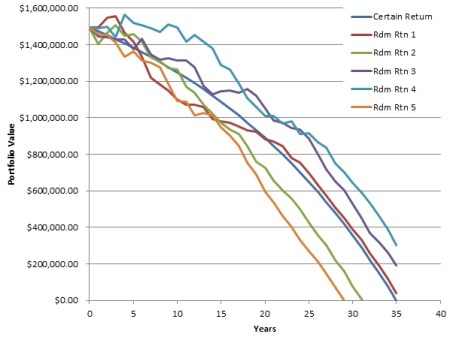
A column by Gail MarksJarvis in the Chicago Tribune over the weekend talked about the danger of planning your retirement with average returns. It’s a simplified story quoting “experts” rather than explaining the math. Pages 153-156 of Basic Personal Finance illustrate this exact topic with a concrete example. It’s based on The Flaw of Averages, a book by former professor, Sam Savage.

Basic Personal Finance uses a scenario developed in the math appendix: a 35-year plan to live off $80,000 per year from a portfolio of $1.5M that continues to grow at 4%. Using average returns, the portfolio lasts exactly 35 years. Simulating returns with a normal distribution with 4% average and 3% standard deviation, the portfolio runs out of money before year 35 over half the time (53%). As Sam Savage said, “answers from average data are wrong on average.” Here’s the graph from the book that shows 5 random trials along with the certain return plot.

Img12 - Returns

Lesson: either add some stochastic element to your retirement planning or add a good cushion to make sure you can weather the years with returns below the average you plan to earn.


Discipline, Not Income, Prevents Debt

A recent post by @akieler on consumerist.com (part of Consumer Reports) reports on a Northwest Mutual commissioned survey that says the average debt (excluding mortgages) for U.S. adults is $37,000. This is a case where being below average would be good!

Although it was an online survey, the results are disturbing:

  • 21% were unsure what portion of their income goes to debt repayment
  • 18% only make minimum payments
  • 14% expect to be in debt for the rest of their lives
  • 25% admit to excessive/frivolous spending

Yet when asked what change would most significantly impact their financial situation, only 7% said “having a comprehensive financial plan.” The most common response was essentially more money (36%). This may sound heartless, but no amount of money will resolve debt problems that result from a lack of fiscal discipline. From the survey: 40% of discretionary income goes to “entertainment, leisure travel, hobbies, etc.”, while only 33% goes to paying off debt. Debt piles up when you’re living beyond your means.

Forty percent of respondents said they experience moderate to high levels of anxiety based on their debt. Despite these feelings, when given the choice of how to spend an extra $2,000, 60% said they would not use it to pay down debt (although 40% said they would put it in savings… a little silver lining).

People who are struggling with debt need to establish fiscal discipline and stick to a budget. That’s Chapter 2 of my book, Basic Personal Finance.

Trade Protections Beget Trade Wars… We All Lose

I’m trying to keep politics out of the blog, but it appears the talking heads on TV and Capitol Hill don’t understand basic economics. They’re spouting a lot of hot air about trade and tariffs, things that anyone who stayed awake in Econ 101 would know are incorrect and/or harmful.

Sadly, many classes these days only teach a macroeconomic perspective of international trade, focusing mainly on exchange rates and current account balances. But I’m a micro guy, and from my perspective, all that stuff misses the point of trade. Trade is between individuals, not nations. Both parties come together to make a mutually beneficial transaction… both of them are better off afterward. There is no difference between trading with your neighbor, trading with a guy in another city, or trading with a guy in another state or another country. (Read about the microeconomic view of international trade.)

Don’t get me started on the trade deficit. Trade imbalances are purely academic. There is an exchange: they give us goods, we give them money… worthless paper if they don’t buy something back from us or trade that paper to someone else. Everyone I know has a HUGE trade deficit with their local grocery store. That doesn’t mean we’re somehow in danger of being taken over by the store or that we won’t be able to continue buying groceries.

The only thing trade protection does is harm consumers. Worse, as soon as other countries enact their own protections, the protectionism also harms the original nation’s exporters. You don’t need to look very far. Just last week, Canada imposed restrictions on U.S. dairy products. The U.S. is now talking about a tariff on Canadian lumber.

It only takes about 15 minutes to teach kids the benefits of trade with bags of candy. Why is it so hard for politicians to figure it out? While they’re busy playing to populist sentiments, they’re ignoring the lessons of economics and history (look up the Smoot Hawley Tariff).